
June 2026
Artificial intelligence (AI) is a technology that enables computers and machines to mimic human learning, understanding, problem-solving, decision-making, creativity, and autonomy.
 Image..
bernardmarr.com
Image..
bernardmarr.com Applications and devices equipped with AI can perceive and recognize objects. They can understand and respond to human language. They can learn from new information and experiences. They can provide detailed recommendations to users and experts. They can act independently, eliminating the need for human intelligence or intervention (a classic example of this is a self‑driving car).
In 2024, most AI researchers, practitioners, and the majority of AI‑related news stories will focus on breakthroughs in generative AI (gen AI), a technology capable of generating original text, images, videos, and other content. To fully understand generative AI, it is important to first gain insight into the technologies on which generative AI tools are based: machine learning (ML) and deep learning.
 Image..
unric.org
Image..
unric.org MACHINE LEARNING
Machine learning falls directly under the umbrella of AI; it involves developing models by training an algorithm to make predictions or decisions based on data. It encompasses a wide range of techniques that enable computers to learn from data and draw conclusions from it, without being explicitly programmed for specific tasks.
There are numerous machine learning techniques and algorithms, including linear regression, logistic regression, decision trees, random forests, support vector machines (SVMs), k-nearest neighbors (KNN), clustering, and many more. Each of these approaches is suitable for different types of problems and data.
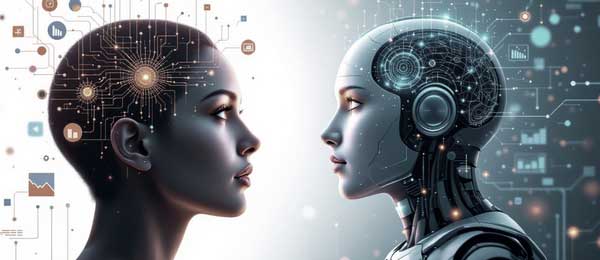 Image..
www.encodedots.com
Image..
www.encodedots.com One of the most popular types of machine learning algorithms is the neural network (or artificial neural network). Neural networks are modeled after the structure and functioning of the human brain. A neural network consists of interconnected layers of nodes (similar to neurons) that work together to process and analyze complex data. Neural networks are ideally suited for tasks that require the recognition of complex patterns and relationships in large amounts of data.
The simplest form of machine learning is called supervised learning. In this approach, labeled datasets are used to train algorithms to classify data or accurately predict outcomes. In supervised learning, humans assign an output label to each training example. The goal is for the model to learn the relationship between inputs and outputs in the training data so that it can predict the labels of new, previously unseen data.
Conclusion: The field of artificial intelligence has made remarkable progress in recent years and has had tangible implications for people, institutions, and culture.
Reference.. www.ibm.com