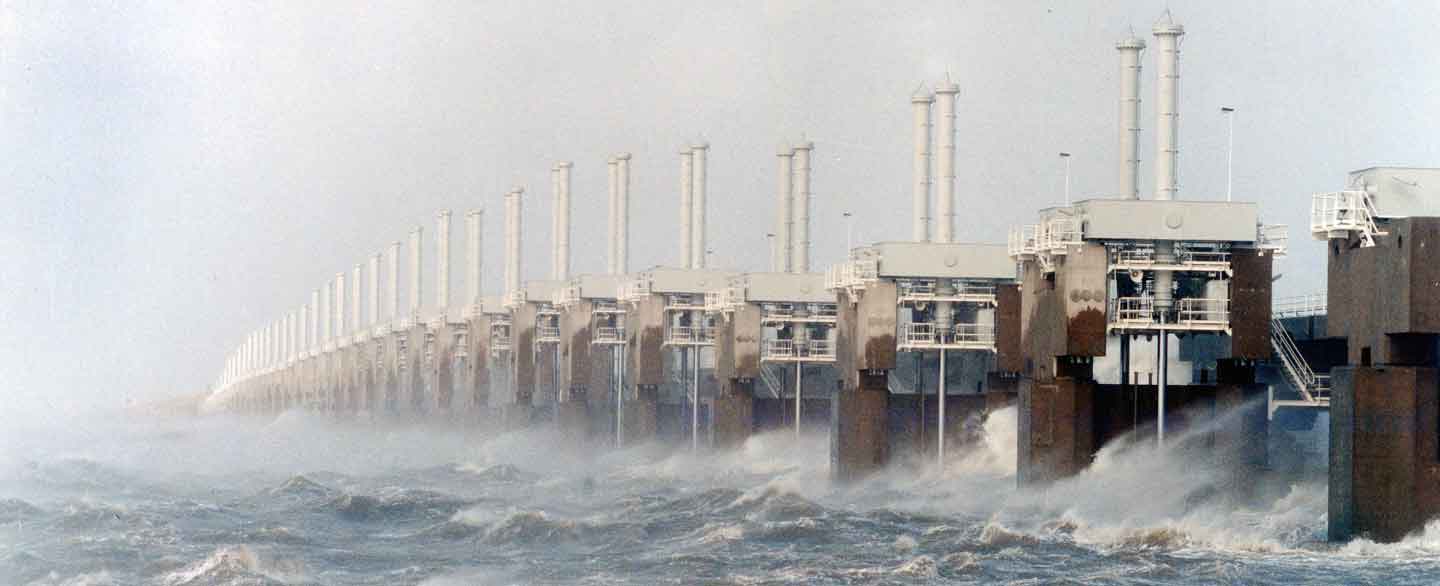
The Oosterscheldekering (surge barrier) between the islands Schouwen-Duiveland and Noord-Beveland, is the largest of the 13 ambitious Delta Works series of dams and storm surge barriers, designed to protect the Netherlands from flooding from the North Sea. The construction of the Delta Works was in response to the widespread damage and loss of life due to the North Sea Flood of 1953.
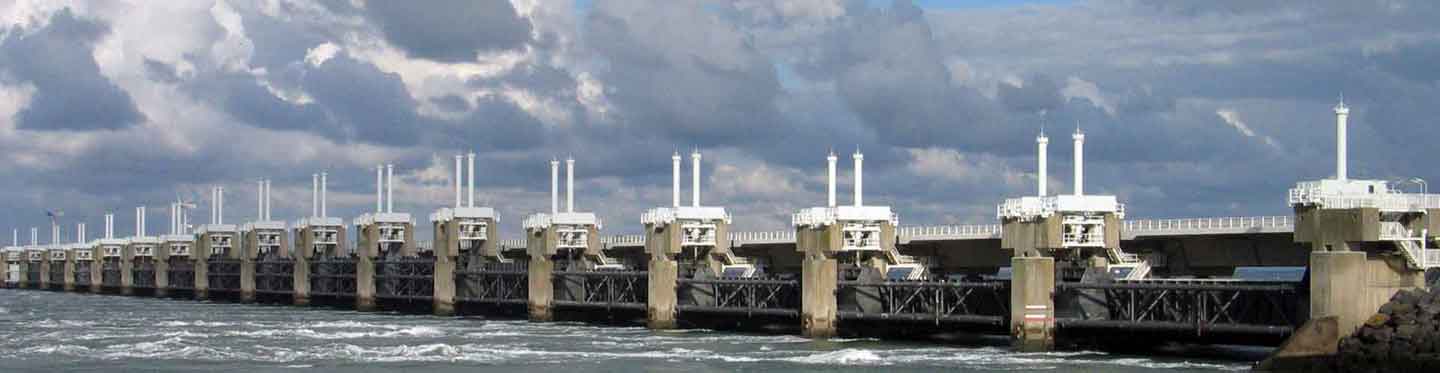
The nine-kilometre-long Oosterscheldekering (kering meaning barrier) was initially designed, and partly
built, as a closed dam, but after public protests, huge sluice-gate-type doors were installed in the
remaining four kilometres. These doors are normally open, but can be closed under adverse weather conditions.
In this way, the saltwater marine life behind the dam is preserved and fishing can continue, while the
land behind the dam is safe from the water.
On 4 October 1986, Queen Beatrix officially opened the dam for use by saying the well-known words.. "De
stormvloedkering is gesloten. De Deltawerken zijn voltooid. Zeeland is veilig." (The flood barrier
is closed. The Delta Works are completed. Zeeland is safe.)
At the artificial island Neeltje-Jans, at one end of the barrier, a plaque is installed with the words.. "Hier
gaan over het tij, de wind, de maan en wij" ("Here the tide is ruled by the wind, the moon and
we (the Dutch)").
The Oosterscheldekering was the most difficult to build and most expensive part of the Delta works.
Work on the dam took more than a decade. It was constructed by a consortium of contractors comprising
Ballast Nedam, Boskalis Westminster, Baggermaatschappij Breejenhout, Hollandse Aanneming Maatschappij,
Hollandse Beton Maatschappij, Van Oord-Utrecht, Stevin Baggeren, Stevin Beton en Waterbouw, Adriaan Volker
Baggermaatschappij, Adriaan Volker Beton en Waterbouw and Aannemerscombinatie Zinkwerken. Construction
started in April 1976 and was completed in June 1986. The road over the dam was ready for use in November
1987.
The road was opened by the former queen, Princess Juliana on 5 November 1987, exactly 457 years after
the St Felix Day's flood of 1530, which had washed away a large chunk of Zeeland, upstream of the new
barrier's position.
To facilitate the building, an artificial island Neeltje-Jans was created in the middle of the estuary.
When the construction was finished, the island was rebuilt to be used as education centre for visitors
and as a base for maintenance works.
The dam is based on 65 concrete pillars with 62 steel doors, each 42 metres wide. The parts were constructed
in a dry dock. The area was flooded and a small fleet of special construction ships lifted the pillars
and placed them in their final positions. Each pillar is between 35 and 38.75 metres high and weighs
18000 tonnes. The dam is designed to last more than 200 years.
The Oosterscheldekering is sometimes referred to as the eighth Wonder of the World. It has been declared
one of the modern Seven Wonders of the World by the American Society of Civil Engineers.
Reference(s) ..www.deltawerken.com