Suez Canal
The Suez Canal in Egypt is a man-made, sea-level waterway in northeastern Egypt that connects the African continent with Asia. It is an important canal connecting the Red Sea with the Mediterranean Sea and was constructed to shorten travel time between the Indian Ocean and the Atlantic Ocean. The canal runs along the Isthmus of Suez, a narrow strip of land separating Africa and Asia.
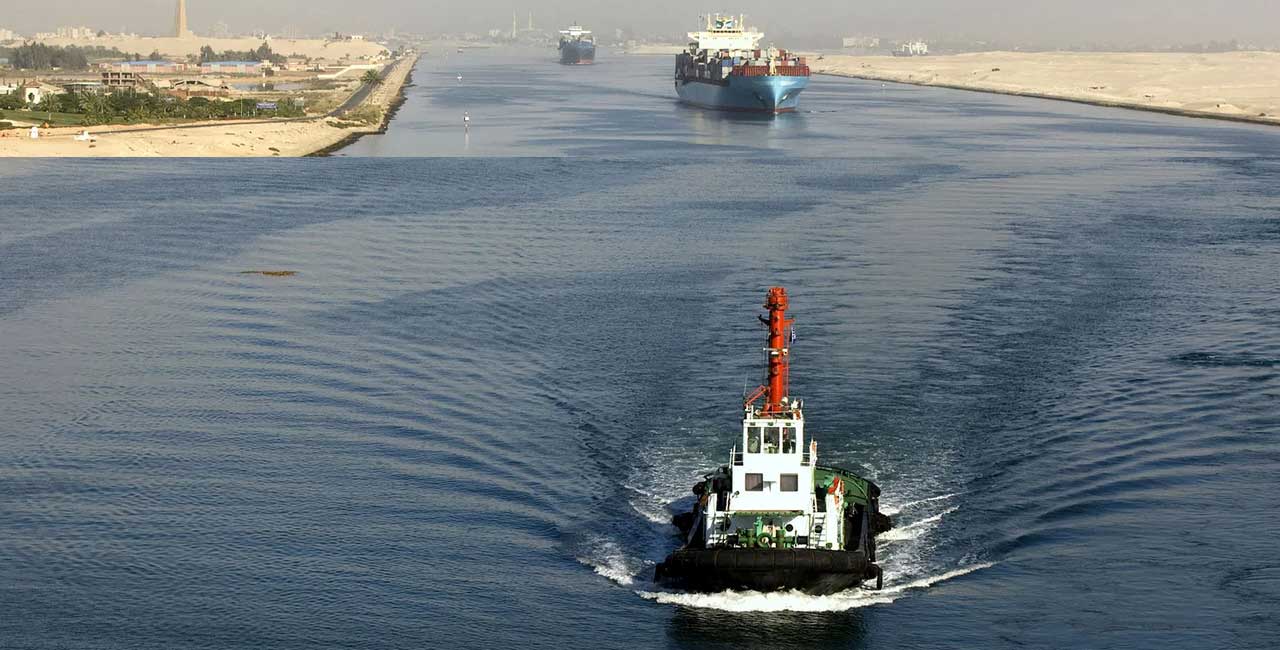
Few maritime passages have revolutionised the world quite like the Suez Canal. Nestled in the heart of Egypt, and straddling the natural divide between Asia and Africa, this artificial sea level waterway acts as the bridge between the Mediterranean and the Red Sea.
Today, with nearly 90 percent of the world’s trade carried by sea, the Suez Canal is rightfully considered one of the busiest and most consequential shipping routes on the planet.
Ancient Ambitions
Even in the era of the pharaohs, the idea of connecting the Red Sea with the Mediterranean Sea was central to the minds of leaders.
More than 4,000 years ago, during a period when Egypt was at the height of its cultural and architectural flourishing, Pharaoh Senausret III had the vision to harness nature for trade and control.
During his reign, the first rudimentary canal was constructed, connecting the fertile banks of the Nile with the waters near the Suez Canal. Remnants of these early efforts can still be found near the present day Suez Canal and serve as a lasting reminder of the desire to unite two great bodies of water.
In the subsequent centuries, various rulers attempted to revitalize and strengthen this connection, although the canal's functionality remained limited.
It was not until the 19th century that interest in this old ambition flared up again, even after the canal had been deliberately filled with sand in the period around 760 AD. The promise of a direct maritime connection between Europe and Asia rekindled the interest of both investors and visionaries.
The dawning of the modern era
Amidst this era of innovation and industrial expansion, the French diplomat and engineer Ferdinand de Lesseps became the principal architect behind what would soon become the modern Suez Canal.
De Lesseps believed that a canal through the Isthmus of Suez would not only revolutionize world trade but also strengthen French influence in a rapidly changing geopolitical landscape.
The first formal step was taken on November 30, 1854, when the Egyptian Viceroy Said Pasha granted de Lesseps the First Concession.
This historic document gave him the right to undertake the arduous task of digging a canal that would connect the Mediterranean Sea with the Red Sea.
The terms of the concession were remarkably detailed. The new company had to be established under strict conditions, including a mandatory presidential appointment by Egypt.
It included a guarantee that the concession would last 99 years and an obligation to surrender 15 percent of the net profits to the Egyptian treasury. The transit costs were to be determined by mutual agreement and applied equally to all interested nations, a provision intended to ensure the neutrality of the canal.
Two years later, on January 5, 1856, the Second Concession was issued. This document, consisting of 23 carefully drafted articles, clarified and strengthened the commitments in the first.
Article 14, in particular, established the principle of neutrality. The canal would be open without distinction to any merchant ship, regardless of nationality or flag, thereby perpetuating the waterway as a global asset rather than an instrument for national gain.
On December 5, 1858, De Lesseps founded the Universal Suez Ship Canal Company, La Compagnie Universelle du Canal Maritime de Suez, with a capital of 200 million francs.
However, as the plans progressed, opposition began to emerge. Great Britain, the dominant naval power with a strong interest in maintaining its supremacy on the open sea, believed that the canal was a potential means to undermine their established shipping routes, particularly given their preference for a rail link between east and west.
Behind the scenes, an international commission was formed between 1855 and 1856 to investigate the feasibility of piercing the Isthmus of Suez, weighing the technical challenges against the expected economic and strategic benefits.
Their deliberations ultimately lent further legitimacy to the ambitious project. And so the way was cleared for the next phase, a construction period marked by incessant labor, innovation, and political maneuvering a period that would transform the Lesseps dream into a technical marvel whose legacy lives on to this day.A decade of hard work and innovation
On April 25, 1859, construction began near present-day Port Said. The scale of the project was truly astonishing: an estimated 2.613 million cubic feet of earth were moved to construct a waterway that would connect two major seas.
Initially, the project relied heavily on forced labor. Tens of thousands of men were forced to
work under notorious, harsh conditions, which tragically led to high mortality rates. Their sweat and
blood formed the foundation upon which this monumental feat of engineering was built.
In 1863, international criticism and unrest among influential figures forced the Egyptian authorities
to intervene. Forced labor was abolished, a decision that, paradoxically, actually promoted the canal's
progress rather than slowing it down.
Now forced to embrace modern technical innovations, the Suez Canal Company introduced custom made, steam and coal powered excavators and dredgers, realizing one of the earliest examples of industrial mechanization in large scale civil engineering works. These new machines played a crucial role in moving earth at a pace impossible to match by hand.
Alongside this mechanized progress, cities such as Port Said and Ismailia emerged virtually overnight, designed to accommodate the growing workforce and create a microcosm of industrial life along the canal's route.
The financial demands of the project remained astronomical. Initially estimated at 200 million francs, the costs of excavating a canal of this magnitude pushed the limits of engineering budgets at the time.
The scale of the investment, combined with domestic discontent, ultimately led to financial instability.
In 1875, Egypt was forced to sell a 44 percent stake in the canal to Great Britain, a move that would have far-reaching political consequences in the years that followed. The culmination of this decade of hard work was celebrated on August 18, 1869, when the Mediterranean Sea and the Red Sea merged for the first time into a single continuous body of water.
The Inauguration
On November 17, 1869, the Suez Canal was inaugurated during a grand ceremony. Thousands of dignitaries gathered along the banks of the newly opened waterway.
The canal was officially measured at 164 kilometers in length, with a width of 52 meters at water level and a depth of 75 meters.
The early period, however, was not without challenges. Trial voyages showed that ships with a draft of more than 6.8 meters were denied entry for safety reasons, and for nearly two decades, shipping was permitted only during the day.
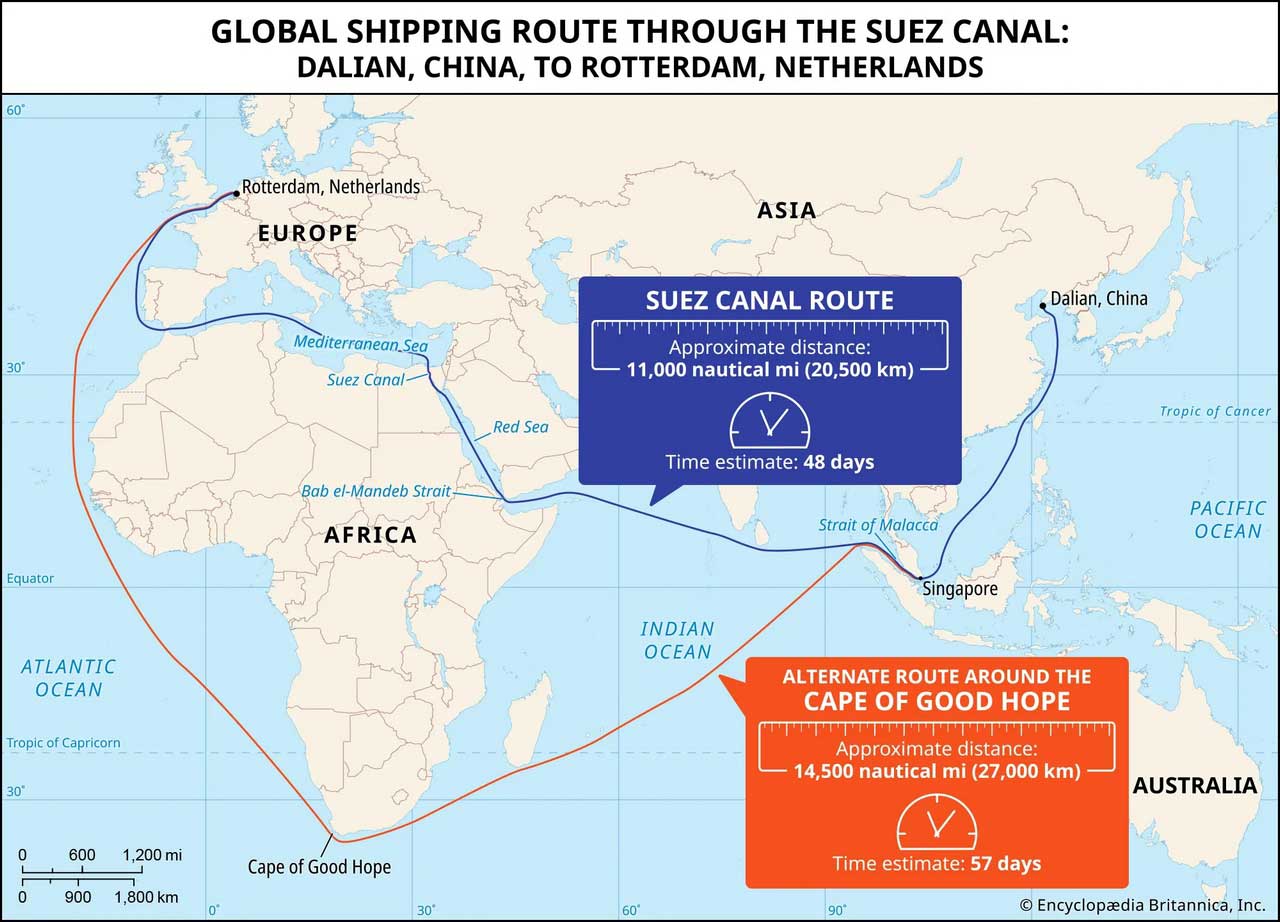
However, these technical limitations paled in comparison to the direct impact of the canal on international shipping. Routes that previously required a detour around Africa often involving unpredictable weather and long travel times; now offered a direct, fast connection between Europe and Asia.
The canal was not just a passage between two seas. It was a symbol of progress and humanity's courage to overcome seemingly insurmountable challenges.
The Treaty of Constantinople
As the Suez Canal consolidated its position in the world, the geopolitical landscape underwent a dramatic change, giving rise to the Treaty of Constantinople.
Signed on October 29, 1888, the treaty is an international agreement guaranteeing that the Suez Canal remains open at all times to both merchant ships and warships, in times of both peace and war, without distinction of flag.
Importance of the canal
At the beginning of the 20th century, as the Suez Canal developed into a crucial component of global strategic strategy, the specter of modern warfare loomed.
In 1956, Egyptian President Gamal Abdel Nasser made the decision to nationalize the Suez Canal Company; a bold expression of Egyptian sovereignty and a direct challenge to the remnants of colonial rule. The subsequent dismantling of the established management and the controversial process of shareholder compensation sent shockwaves worldwide.
The turning point came in June 1975 when President Anwar El Sadat announced the reopening of the canal to bring about a cautious return to normality. Nevertheless, the canal would continue to influence international politics well into the late 20th century and beyond.
The reopening of the Suez Canal in 1975 marked not only a symbolic rebirth but also the beginning of ongoing modernization.
Extensive efforts focused on deepening and widening the existing waterway to accommodate the larger ships that had become the norm in the era of container shipping.
Bypasses were also constructed, designed to facilitate two way traffic across large sections of the canal.
In addition to these measures, significant improvements were made to the canal crossings, including state-of-the-art bridges and tunnels, to improve connectivity and operational reliability.
The most important recent undertaking was completed in 2015.. the New Suez Canal Project, which involved constructing a new, 35 kilometer-long parallel shipping route alongside the original canal.
The passage of megaships convincingly demonstrated the canal's improved capacity. These ships, once considered too large for the traditional passage, could now easily navigate the modernized corridor.
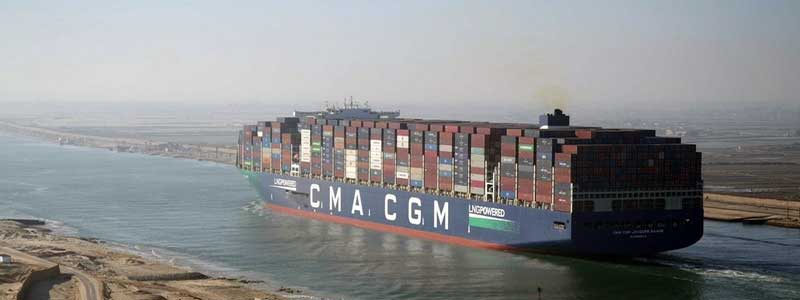
Image.. Suez Canal Authority
Sources and References.. The sources are not
specifically named here; dozens can be found online.
This article is a summary of multiple reliable sources.
Related Post(s)
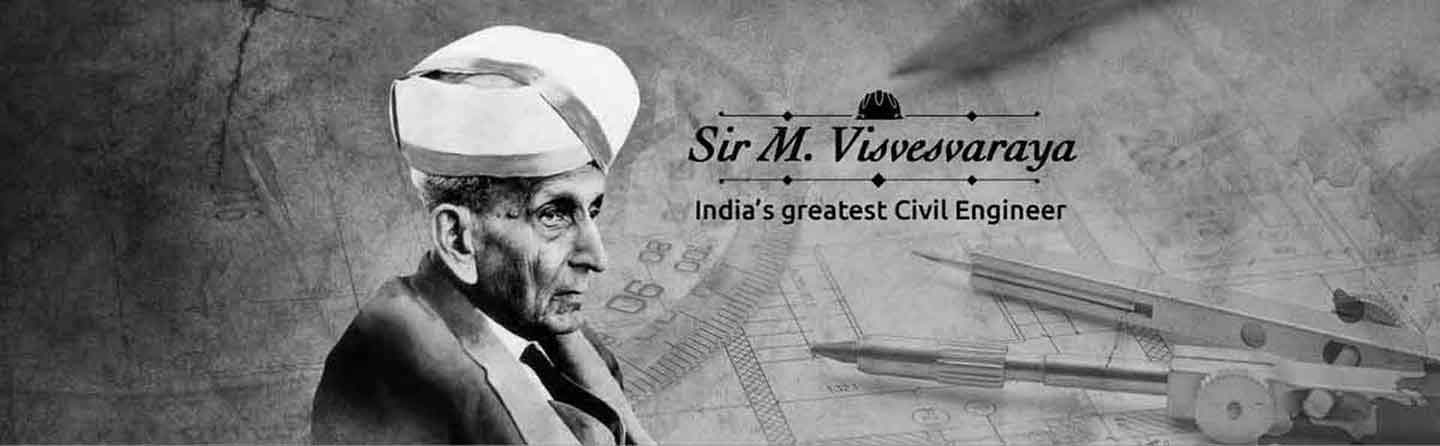
In remembrance of Sir Mokshagundam Visvesvaraya, the most outstanding Engineer of all times, the Engineering fraternity of India celebrates “Engineer's Day” every year on 15th of September...