|
Pipe spools |
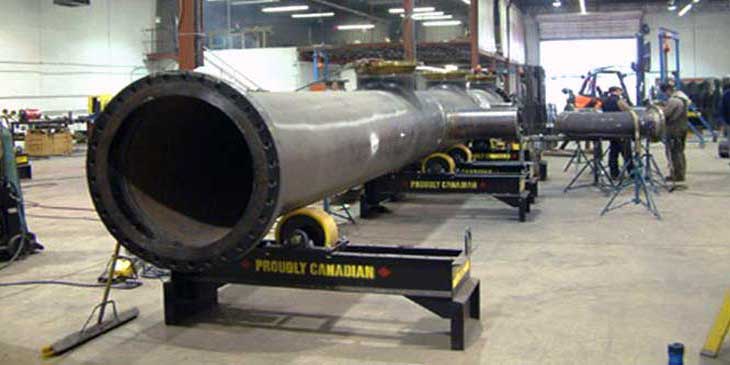
Pipe spools play a vital role in the engineering and construction (piping) industry. They are prefabricated pipe segments, manufactured in a protected and controlled environment (workshop), that connect larger systems, simplifying on-site assembly and reducing labor costs on the jobsite.
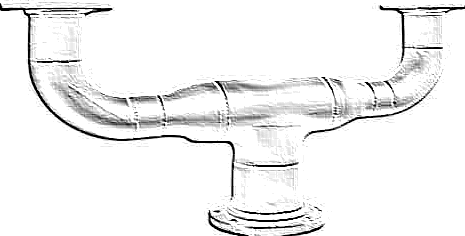
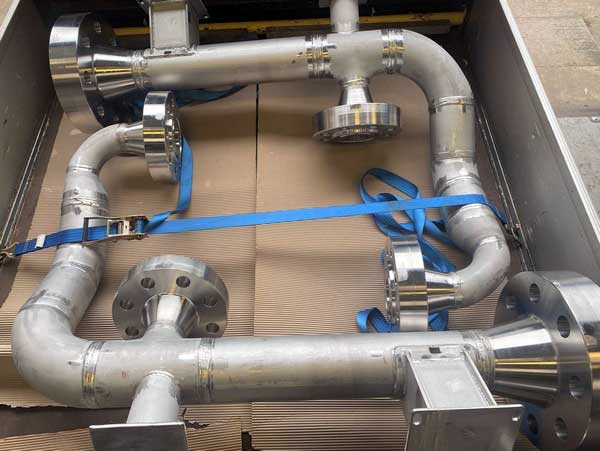
Pipe spools consist of components such as pipes, fittings, flanges, and valves (if welded), which are custom-fabricated to a specific system design. This custom approach simplifies on‑site installation while ensuring the system's integrity and functionality.
Prefabricating pipe spools offers significant practical and financial advantages. Controlled factory conditions enable the use of advanced equipment, optimized work processes, and improved ergonomics, resulting in higher precision, weld quality, and consistency. This reduces human error, improves system reliability, increases safety and productivity, while minimizing installation time and on‑site labor costs.
Design and engineering form the foundation for pipe spool manufacturing and ensure seamless integration into the larger piping system. Accurate planning prevents problems during assembly, installation, or commissioning that can lead to costly delays or malfunctions. Detailed work preparation during this phase is crucial for a reliable and efficient system.
The process begins with the creation of isometric drawings that define the dimensions and connections of the pipe spool. These blueprints ensure that the spool fits correctly into the system and meets the functional requirements. Advanced modeling software (3D) helps simulate layouts, detecting potential design conflicts or deviations early on, saving time and resources.
A pipe spool drawing (preferably isometric) is a detailed technical illustration used in the design and manufacture of pipe spools. It provides a complete overview of how the spool components should be assembled and installed. Key elements typically included in a pipe spool drawing are described below.
Remark(s) of the Author...
My own experiences with Pipe spools
As this article has already described, prefabricating pipe spools is a very useful contribution to the success of a project and is generally carried out by all piping companies, especially for larger projects.
However, in my experience, uniquely numbering pipe spools can become a major problem if unclear or vague agreements have been made about it.
Also consider the following regarding numbering each spool with a unique label:
These few notes regarding numbering during prefabrication of pipe spools, should be kept in mind.
Exceptional example of incorrect spool numbering
Several years ago.. one of the world's largest engineering companies was awarded a contract for a multi‑billion dollar project in the Netherlands.
The THOUSANDS of pipe spools were made in various European countries and were delivered to the new location on HUNDREDS of freight trailers.
After the first shipments, the spool numbering system turned out to be incorrect or inaccurate, and the misery that then began is almost indescribable.
For example, it was not possible to determine from the freight trailer to which floor (building/steel
structure approximately 70 meters high) a particular spool had to be lifted with a crane.
Once the correct floor had been found, it turned out that many more coordinates were incorrect.
Dozens of engineers, draftsmen and contractors were involved in the correct distribution of the
spools; on some days, more than a hundred people worked on it.
The end result was disastrous, with enormous additional costs (millions) and a much‑delayed delivery of the entire project.
Ultimately, this led to the bankruptcy of an entire large and important department of the engineering company.
In addition, many local and international suppliers and contractors were also negatively affected by this huge mistake with the pipe spools.
However, it should be noted that the multinational company that had ordered the new plant provided financial support to local companies. Unfortunately, I am not aware of any international financial help.
If you have read the Remarks(s), you can conclude for yourself how important
correct pipe spool numbering is. Even for small projects with limited numbers of pipe spools, you
will benefit greatly from a good numbering system.
It's up to you to make the best of it.
Related Post(s)