

189 - 181 questions
Question 189..but what if it's a fuel-powered lawnmower?
Hi Werner, I'm Morten Larsen, and have been following your website for years with great interest.
I read your post about Wastewater Treatment yesterday, and it was very useful and informative.
I would like to point out that waste management and the associated issues exist in all of our homes. In your remarks, you mentioned an electric lawnmower as an example. Cleaning it probably won't release any further waste; but what if it's a fuel-powered lawnmower?
What I'm trying to say, in short, is that we all regularly produce waste that's not under control.
Greetings,
Morten Larsen
from Denmark
March 8, 2026
Dear Morten,
I was surprised by your quick response; I published the article a few days ago.
Yes, you're right, we all produce waste that could perhaps be better managed, processed, and cleaned.
In my opinion, each individual should decide for themselves what is and isn't responsible when it comes to waste disposal.
In the country where I live, governments have guidelines (not legal rules) for this, and it is therefore up to each individual to adhere to them as best as possible... but I fear that the environment does not benefit from it.
Groetjes,
Werner
March 9, 2026
Question 188..Is there an alternative to MSS SP-83 union couplings?
Hello Werner,
Our engineering department is working on a project that involves installing dozens of pumps. We want
to use MSS SP-83 union couplings to connect the various small bore supply pipes to the relevant pumps.
However, several people in our department have asked whether there are any alternatives to these unions.
I am now putting this question to you.
Kind regards,
Yang Tao
January 9, 2026
Hi Tao,
I don't know why the question is being asked, but in my opinion, that's a good point.
In a company with hundreds of different pumps, all of which were equipped with UNION couplings, I had to have the couplings replaced with flange connections. The screwed couplings began to leak at the large nut.
It should be noted that all these union connections had been in use for years and were regularly opened for pump maintenance.
During that period and afterwards, I looked for alternatives to those unions, but to the present day I have not found a usable and affordable alternative.
Of course, the choice is up to your department, but with proper maintenance, the SP-83 unions will serve you well for many years.
greetings Werner
January 10, 2026
Hello Werner,
Thank you for your response.
We are considering using flange connections, which was previously suggested within our team. Although
this is a more expensive solution, it gives us a greater sense of security. We will present both options
to our customer.
Kind regards,
Yang Tao
January 12, 2026
Good luck!
greetings Werner
January 13, 2026
Question 187.. spiral wound gasket that did not have an outer and inner ring?
Hello Werner,
A time ago I came across a spiral wound gasket that did not have an outer and inner ring. Were sometimes both rings manually removed, or do these gaskets also exist in this design? If so, where are these "ringless" gaskets typically used?
Regards,
Sebastian Bouchard
Hi Sebastian,
The ringless version does indeed exist as e.g. the type R of Flexitallic. This type is used in a flange connection where one flange has a compression ring and the other flange has a groove. These flanges are called "Tongue & Groove" flanges in piping.
The groove eliminates the need for the outer and inner rings, because the gasket is pressed into the groove with the help of the compression ring (Tongue), which is used to seal the gasket.
On this page you will find images (3-4) and dimensions of Tongue & Groove flanges
The above is an example, however, there are more situations where spiral wound gaskets, without outer and inner rings are used.
greetings Werner
May 15, 2024
Question 186.. are lokring fittings suitable in propane service?
Hi Werner,
Are lokring fittings suitable in propane service?
Thanks in advance for your reply,
Regards,
Paul Warren
Hi Paul,
Standard fittings are not suitable for use at low temperatures, but the Lokring fitting 4130 Alloy
Steel (LTCS-333) is a process fitting, which is suitable for low temperatures.
The .pdf file below gives you a brief overview about 4130 fittings.
greetings Werner
October 12, 2023
Question 185.. is there any information about the real thickness in (short radius) elbows?
Hello Werner,
Is there any information about the real thickness in (short radius) elbows?
Since they are madrel made I think the wall thickness in the inner radius will be more than in the outer
radius.
Met vriendelijke groet,
With kind regards,
Cordialement,
Herman Schutten
Engineer
Hi Herman,
The wall thickness at the weld line location is standardized, but not through the rest of the fitting. The standard B16.9 states that the minimum tolerance will be within 12.5% of the minimum ordered wall thickness of the pipe. A maximum tolerance is specified only at the ends of the fitting.
Many providers of butt weld elbows provide one schedule greater thickness so that sufficient wall thickness, after forming, remains.
I also took a quick look at the latest ASME B16.9 standard.
Para 2.2.2 talks about design and para 9.1 talks about required testing. Nothing about actual wall thicknesses
of elbows to be found.
greetings Werner
January 11, 2023
Question 184.. can ring joint gaskets be reused?
Good day Mr,
In a few weeks we want to hydrostatically test a pipe system, where Ring Typ Joint flanges are used. For a good seal, we want to use the octagonal rings, which are prescribed for the respective flanges. Once the test is done, all the pipe sections will be disassembled, and transported to an external location.
My question is: can we reuse the octagonal rings?
Thank you in advance for your response.
Best regards,
Radu Dragomir
Hi Radu,
Ring type joints are designed to have a limited amount of positive interference, which ensures that the ring type joint seats correctly into the groove on compression. Their reuse is not recommended for two reasons..
Please also check out Gaskets for flanged Connections
greetings Werner
Question 183.. dimensions male & female flanges
Good morning Werner,
I still use your site regularly. Actually, ever since I did an internship at the company where you worked at the time.
At my employer we have a unit where chlorine is processed and male female flanges are used. The problem is that I can only find very little information regarding measurements, not even in the VOMI fitters booklet.
Do you see an opportunity to add it to the site if you could get the information? This would be of great help to me and other colleagues.
Yours sincerely,
Mike Oskam
Hi Mike,
Thanks for the interest in my website.
On page Male Female and Tongue & Groove you will find my answer.
The overall dimensions of the Male and Female flanges correspond to the standard dimensions according to ASME b16.5, so I have not added those dimensions either.
The length of the stud bolts is either the same or slightly shorter.
I'm still going to see if it's necessary to add the Stud Bolt lengths.
Gr, Werner
Question 182.. klopt het dat de afmetingen van DIN flenzen er niet meer in staan..
Goedendag heer Sölkers,
Wij kennen elkaar niet persoonlijk, maar ik ken u van de enorm nuttige website, die ik bijna dagelijks
gebruik.
Klopt het dat de afmetingen van DIN flenzen er niet meer in staan?
Ik werk bij een oude plant die oorspronkelijk gebouwd is volgens de DSM-standaarden, dus NEN-DIN. Maar
nu kan ik op de website de DIN specificaties niet meer terugvinden, en dat is niet handig. Inmiddels
zijn de huidige standards en pipespecs wel allemaal gewijzigd naar ASME/ANSI, maar we hebben nog veel
te maken met de geschiedenis van de fabriek.
Willem Zuyderduyn
Piping engineer
Hallo Willem,
Artikelen over DIN vindt je inderdaad niet meer in het hoofdmenu DIN. Om allerlei redenen heb ik DIN naar het menu 'SOCIETIES' verplaatst. Welding Neck Flanges Type 11 . DIN is dus nog steeds 'aanwezig'.
Overigens heb ik ook voor een 'oude' plant de BS 3293:1960 British Standard toegevoegd. Deze flens afmetingen kwam ik kort geleden nog tegen, en de gegevens daarover waren nihil. De link brengt je naar de norm BS 3293:1960
Gr, Werner
Question 181.. what is the difference between relief and safety valve..
Dear Werner Solken,
For my study I have to answer the question 'what is the difference between relief and safety valve?. Can you give me a little help please.
Thank you in advance.
Kind Regards,
Anil Patel
Hi Anil Patel,
Relief or Safety valves perform the following basic functions.
They protect a system against excessive pressure or sudden increases in pressure. When the pressure in a line reaches a pre-set high pressure, the valve opens and allows the pressure to escape either to atmosphere or to another part of the system. Safety valves are generally used for steam, air or other gases. Relief valves are usually used for liquids.
| Relief valves versus Safety valves | |
| Relief Valve | Safety Valve |
| Purpose is to limit pressure to a specific pressure. | Fail-safe purpose, protect people, property and environment. |
| Opens proportional to the pressure increase. | Starts opening before the set pressure and pops open at the setpoint or at a defined point. |
| Opens when the pressure reaches a set pressure limit. | Starts opening before the set pressure limit. |
| Can not be used at maximal overpressure values of 3% maximum allowable operating pressure (MAWP) | Can be used at maximal overpressure values of 3% MAWP |
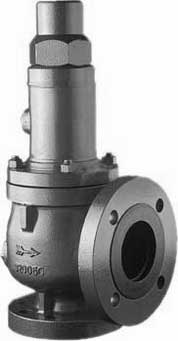
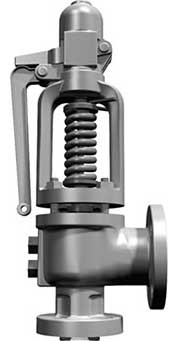
greetings Werner
