

 |
Differences between CNG‑LNG‑LPG gases |
In the ever‑changing world of energy resources, compressed and liquefied gases have become key players in meeting the diverse energy needs of industries, households, and the transportation sector.
Compressed natural gas (CNG), Liquefied natural gas (LNG) and Liquefied petroleum gas (LPG) are three important gases, each with unique properties that make them suitable for various applications, and are often an alternative to gasoline and diesel.
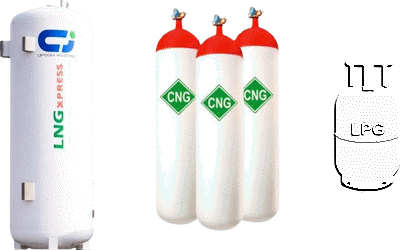
CNG is an environmentally friendly and cleaner‑burning alternative to gasoline and diesel, consisting primarily of methane (CH4). It is produced by compressing natural gas to less than 1% of its volume at standard atmospheric pressure (typically 200‑250 bar) for use in cars and trucks and homes.
Composition and safety: CNG consists mainly of methane, is lighter than air, odorless, non‑toxic and non‑corrosive, although odorants are added for leak detection.
Environmental Impact: It produces lower levels of harmful pollutants, including carbon monoxide and greenhouse gases, compared to traditional fossil fuels.
Uses: Used in specially manufactured or converted vehicles (cars, trucks, buses) to reduce emissions.
Storage and Efficiency: Stored in high‑pressure cylinders, it offers high octane performance and better fuel efficiency in terms of cost per mileage compared to petrol and diesel.
CNG Applications: CNG is compressed on‑site and stored in containers that can be transported by ship, train, and truck. A depressurization system is used at the power plant to reduce the gas pressure. By comparison, LNG requires a dedicated cryogenic terminal at each port and dedicated ships. CNG tankers can reach more remote ports. For power plants with small gas needs located close to gas reserves, it is simpler and less expensive to establish a CNG infrastructure.
(LNG is natural gas (primarily methane) that is cooled to approximately min.162 degrees Celsius until it liquefies, reducing its volume by 600 times. This process enables safe and efficient transport by ship to locations inaccessible by pipelines. It is colorless, odorless, non‑toxic, and non‑corrosive.
Composition and state: It consists mainly of methane (CH4) with small amounts of other hydrocarbons and is stored as a liquid at atmospheric pressure in special insulated tanks.
Objective: The primary objective is to transport natural gas over long distances by ship across oceans, where pipelines are not feasible.
Process: The process involves removing water, oxygen, carbon dioxide, and sulfur compounds before cooling. Once at its destination, it is reheated into gas for use in heating, electricity generation, or as a fuel.
Safety: In liquid form, it is non‑flammable and non‑explosive. If spilled, it evaporates immediately and leaves no residue.
LNG Applications: LNG is primarily used in applications where energy density and clean combustion are crucial. It is widely used as a fuel for electricity generation, heating, and industrial processes. LNG is also gaining popularity as a cleaner alternative for heavy‑duty transport, such as trucks, ships, and buses. Moreover, LNG is a vital component of the global natural gas trade, enabling the transport of gas to distant markets.
LPG is a colorless, low‑carbon, and highly flammable fuel composed primarily of propane and butane. It is used for cooking, heating, and as a vehicle fuel. It is extracted from oil and gas fields or oil refineries. Although it is a gas at room temperature, it is stored as a liquid under pressure in bottles and tanks.
Components: Mainly propane (C3, H8), butane (C4, H10) or a mixture of both, sometimes with small amounts of propylene or butylene.
Storage and transportation: It is stored as a liquid in jerry cans or tanks, making it easy to transport and ideal for off‑grid areas.
Safety: It is colorless and odorless, but a strong, unpleasant odor is added to make leaks easy to detect.
Features: It is heavier than air, which can cause leaks to collect in low places such as drains or basements.
LPG Applications: LPG is used in various sectors, including residential, commercial, industrial, and agricultural. It is widely used as a cooking and heating fuel in households, particularly in areas lacking natural gas infrastructure. LPG is also a versatile vehicle fuel, especially in regions with limited access to gasoline or diesel. LPG also has industrial applications, such as in petrochemical production, metalworking, and as a propellant in aerosols.
Related Post(s)
