|
Vacuum lifting |
To clarify what vacuum technology entails, we'll apply the basic principles
we learned in school.
In our society, we live in an environment of 1 bar, meaning that a pressure of 1 bar is exerted
on us and everything around us from all sides.
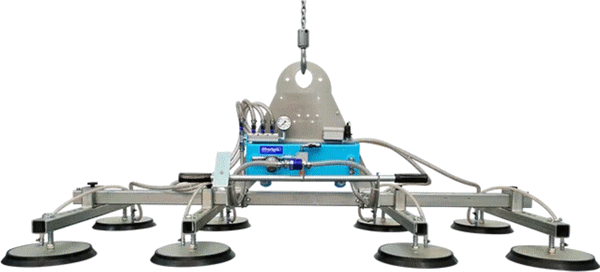
From heavy steel plates to delicate glass panels, vacuum lifters simplify tough material handling tasks. They are an indispensable tool in industries such as manufacturing, construction, and logistics, combining power with precision to lift loads safely, efficiently, and with minimal effort.
The unprecedented power of vacuum handling offers the ability to handle heavy loads without using
conventional lifting equipment such as chains, lifting straps, and slings.
In addition to lifting, a vacuum lifter can also rotate products and handle high tonnages.
The power of a vacuum was first demonstrated in 1654 by Otto von Guericke, the then mayor of Magdeburg, Germany. He performed the famous experiment now known as the Magdeburg Hemisphere Experiment. Otto von Guericke designed the experiment to demonstrate his own air pump and the concept of air pressure. The hemispheres are still used in education today to illustrate the power of air pressure.
The experiment consisted of two large copper hemispheres, each about 50 cm in diameter, and the air pump (vacuum pump) that Otto von Guericke had invented. One hemisphere was connected to the vacuum pump by a hose. The two hemispheres were held together and sealed with grease. The air was then sucked out of the sphere, creating a vacuum inside. Even with fifteen horses pulling in opposite directions on each side, it proved impossible to separate the two halves. We now know that the force that had to be overcome was 20,000 Newtons. That's equivalent to a mass of 2 tons!
Thirty horses weren't enough to separate the hemispheres.
But what exactly holds the two hemispheres together? This is because the air pressure on the outer surface dissipates, forcing the two hemispheres firmly together. On Earth, the atmosphere exerts an air pressure of 1 bar.
By sucking the air out of the sphere, a negative pressure of between 0 and 1 bar is created inside.
All vacuum lifters are essentially designed based on the Magdeburg principle. A vacuum suction cup with an effective surface area of 1m2 can lift more than 4 tons at a good vacuum (almost -1 bar), which is a safe working load, taking into account the necessary safety factors.
From the description above, it can be concluded that vacuum is incredibly powerful and offers unique advantages over other lifting methods. Suction and release take only seconds, making it quick and easy to perform and resulting in higher productivity.
Requires a power supply and sealed surfaces: Vacuum lifters depend on a continuous power supply to maintain suction. A power failure or leak can lead to vacuum failure, making backup systems and check valves essential. The HSE emphasizes that the surface of the material must be smooth and non-porous; rough, oily, or porous surfaces cannot maintain suction.
Risk of loss of load due to seal failure: Any break in the vacuum seal, e.g., caused by a dent, surface contamination, or poor pad contact, can lead to loss of load. Safety experts recommend equipping vacuum systems with visual or audible alarms that signal a loss of pressure. Operators should restrict access to the lifting area and maintain a low lifting height to minimize the consequences of a seal failure.
Regular maintenance required: Vacuum systems require routine inspections, in accordance with industry best practices and as described in manufacturer manuals and HSE (Health and Safety Executive) guidelines. Occupational health and safety regulations also stipulate thorough inspections by a competent person.
Regular maintenance is of course also required for non-vacuum related lifting equipment, and HSE regulations must also be followed.
Limited to non-porous materials: Vacuum lifters are not effective on porous surfaces, such as raw castings or untreated wood. In these cases, mechanical clamps or lifting magnets may be necessary.
Training and Compliance: Operators must understand safe operating procedures. Health and safety authorities recommend training employees in using the correct equipment for the task and following the manufacturer's instructions, which, of course, also applies to non-vacuum-related lifting equipment.
In general, all lifting equipment must be regularly inspected and maintained,
and all legal regulations must be strictly adhered to.
These regulations may vary by state or country, and it is advisable to comply with them.
Related Post(s)