|
Trunnion-mounted Ball valve |
A trunnion mounted ball valve is a type of quarter-turn valve in which the ball is fixed (anchored) by mechanical supports, called trunnions, at the top and bottom, preventing it from moving axially (up/down).
Trunnion-mounted ball valves are widely used in industries that require precise flow control, from oil and gas pipelines to chemical and water treatment plants. Thanks to their unique design, they offer a reliable solution for high-pressure applications and provide better stability and control compared to conventional floating ball valves.
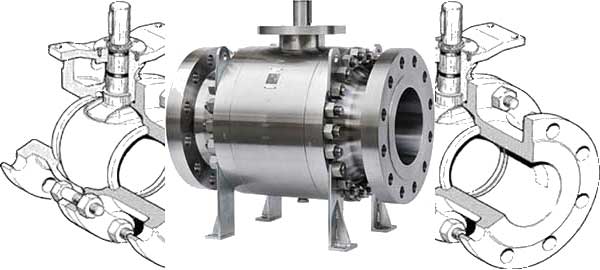
Where standard ball valves use a “floating” ball that is connected only to the spindle, ball valves with a trunnion have a more stable design. In these valves, the ball is secured by two attachment points: the stem on one side and a trunnion (a shaft that provides additional support) on the other. This construction holds the ball tightly in place and reduces the torque required to operate the valve, making it ideal for high-pressure applications.
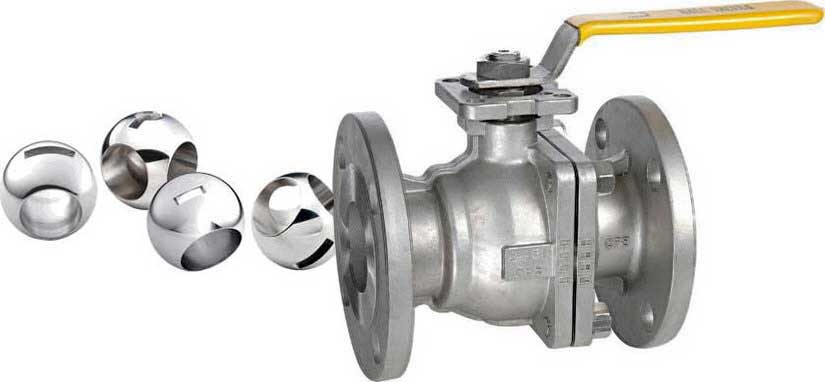
In a floating ball valve, only one side of the ball is connected to the spindle, allowing the ball to move slightly under pressure. This movement presses the ball against the seat on the downstream side, creating a seal.
In trunnion-mounted ball valves, however, the ball cannot shift because it is anchored at both ends. This provides a better seal in both directions and improved performance at high pressure, as the ball remains firmly centered in the valve body.
The operation of a trunnion mounted ball valve is straightforward and is quite simple.
When the valve is open, the ball rotates so that the bore is aligned with the pipeline, allowing fluid to flow unimpeded.
When the valve is closed, the ball rotates a quarter turn, causing the fixed part of the ball to rest against the openings of the pipeline and block the flow.
Quarter-Turn Mechanism
Trunnion mounted ball valves like other ball valves, are quarter-turn valves. By turning the drive
or lever 90 degrees, the ball rotates in the valve body, switching the valve between the open
and closed positions.
Trunnion support and reduced torque
The trunnion, a shaft at the bottom of the valve, provides additional support to the ball. By anchoring
the ball to both the stem and the trunnion, the valve has a stable configuration, requiring less
torque for operation. This makes the valve easier to operate, especially in high-pressure applications.
Sealing mechanism
In trunnion-mounted ball valves, both the upstream and downstream seats are spring-loaded, ensuring
a good seal even under pressure. When the valve is in the closed position, the seats press against
the ball to form a seal, preventing leakage.
Double Block and Bleed Functionality
In trunnion-mounted ball valves with a double block and bleed configuration, both seats provide
independent sealing, blocking pressure on both sides of the valve. This feature is critical for
maintenance and safety, as it allows operators to relieve built-up pressure before performing maintenance
or repairs.

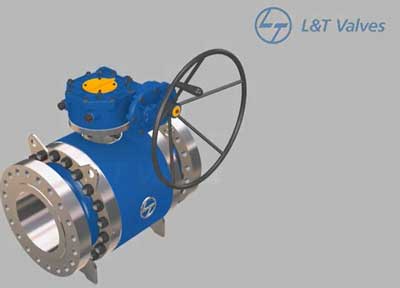

Trunnion mounted ball valves consist of essential components such as the ball, the stem, the trunnion, the bearings, the seats, and the body. The trunnion supports the ball and ensures stability and controlled rotation. Bearings reduce friction, while seats provide sealing against pressure. The body can be opened on the side or top, allowing maintenance without removing the valve from the pipeline.
The materials used in Trunnion mounted Ball valves play a crucial role in their performance and service life. Commonly used materials include steel (in a wide range of grades) for the ball, polymers such as PTFE or metals for the seats, and high-quality gaskets for reliable sealing and low emissions. The choice of materials depends on factors such as pressure, temperature, and the nature of the fluid being controlled.
Although trunnion mounted ball valves offer numerous advantages, they also have some disadvantages:
In short, trunnion mounted ball valves are extremely reliable valves in fluid control systems, offering a secure seal and reliable performance across a range of industries. Understanding their design, functionality, components, materials, applications, advantages and disadvantages, and selection criteria is essential for engineers and operators to optimize fluid control processes and improve system efficiency.
Related Post(s)