
 |
Definition and Details of Threaded Fittings |
updated October 2025
Threaded joints probably represent the oldest method of joining piping systems.
Like Socket Weld fittings, threaded fittings are mainly used for small pipe diameters (Small Bore Piping);
generally for piping whose nominal diameter is NPS 2 or smaller.
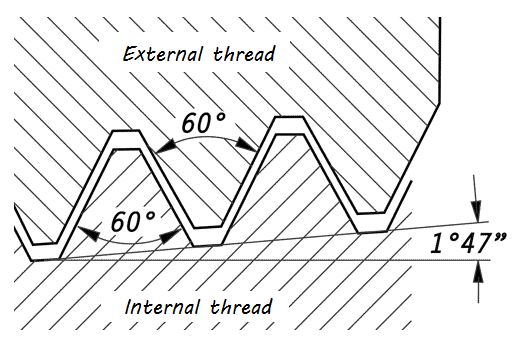
The dimensional standards for taper pipe threads are given in ASME B1.20.1. That document gives
all required dimensions including number of threads per inch, pitch diameter, and normal engagement
lengths for all pipe diameters.
- Threaded piping is commonly used in low-cost, noncritical applications such as domestic water, fire protection, and industrial cooling water systems.
- Threaded fittings are normally made of cast gray or malleable iron, cast brass or bronze, or forged alloy and carbon steel.
- They are available in three pressure ratings.. Class 2000, 3000 and 6000.
NPT Thread
All fittings on this page are described, are provided with NPT thread, ASME B1.20.1. The American National Pipe Thread Tapered, is the best known and most widely used connection where the pipe thread provides both the mechanical joint and the hydraulic seal. NPT has a tapered male and female thread which seals with Teflon® tape or jointing compound.
Dimensions of American Taper Pipe Thread with Sealant Compound
| DN-NPT | Major Diameter mm |
Tapping Drill Size mm |
TPI | Pitch mm |
| 1/16" | 7.895 | 6.00 | 27 | 0.941 |
| 1/8" | 10.242 | 8.25 | 27 | 0.941 |
| 1/4" | 13.616 | 10.70 | 18 | 1.411 |
| 3/8" | 17.055 | 14.10 | 18 | 1.411 |
| 1/2" | 21.223 | 17.40 | 14 | 1.814 |
| 3/4" | 26.568 | 22.60 | 14 | 1.814 |
| 1" | 33.228 | 28.50 | 11.5 | 2.209 |
| 1.1/4" | 41.985 | 37.00 | 11.5 | 2.209 |
| 1.1/2" | 48.054 | 43.50 | 11.5 | 2.209 |
| 2" | 60.092 | 55.00 | 11.5 | 2.209 |
| 2.1/2" | 72.699 | 65.50 | 8 | 3.175 |
| 3" | 88.608 | 81.50 | 8 | 3.175 |
| 3.1/2" | 101.316 | 94.30 | 8 | 3.175 |
| 4" | 113.973 | 107.00 | 8 | 3.175 |
| 5" | 141.300 | 134.384 | 8 | 3.175 |
| 6" | 168.275 | 161.191 | 8 | 3.175 |
| 8" | 219.075 | 211.673 | 8 | 3.175 |
| 10" | 273.050 | 265.311 | 8 | 3.175 |
| 12" | 323.850 | 315.793 | 8 | 3.175 |
Types of Threaded Fittings by Class and Size
| Description | Class Designation | ||
| 2000 | 3000 | 6000 | |
| Elbows 45 and 90 degrees Tees, Crosses, Coupling Half-Coupling, Cap |
1/2 - 4 | 1/2 - 2 | 1/2 - 2 |
| 1/2 - 4 | 1/2 - 2 | 1/2 - 2 | |
| 1/2 - 4 | 1/2 - 2 | 1/2 - 2 | |
| Pipe Wall | SCH 80 / XS | SCH 160 | XXS |
Plugs and Bushings are not identified. They may be used up through Class 6000
Fittings for Threaded Pipe systems
Elbow 90°
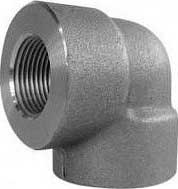
Threaded elbows 90 degrees connect two pipes using internal threads at both ends.
Tee
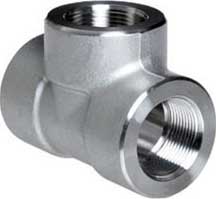
A threaded tee is a three-way pipe fitting with female threaded openings that connects three pipes,
typically with a 90-degree branch from a main line, to combine or split the flow of fluids.
Cross
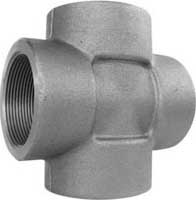
A threaded cross connects four pipes at a single point, with all connections made using threaded
ends. It is also known as a four-way connector.
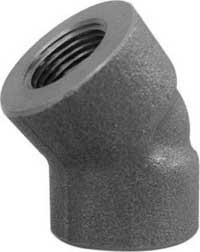
Elbow 45°
Threaded elbows 45 degrees connect two pipes using internal threads at both ends.
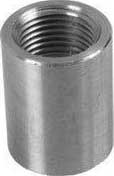
Full-coupling
A threaded full coupling is a pipe connector with female threads on both ends that is used to connect
two pipes to extend or terminate a line.

Half-coupling
A threaded half coupling is used to create a branch connection from a larger pipe, with one end
threaded for connection and the other end either smooth or beveled for welding. It has a threaded
base on one side and a smooth or beveled end on the other.
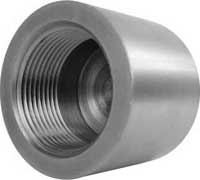
Cap (End Cap)
A threaded end cap is a pipe connector with an internal thread that is screwed onto the external
thread of a pipe to seal its end.
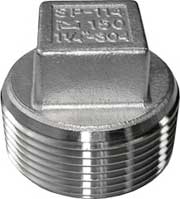
Square head plug
A square thread plug is a connector used to seal and close an open internal thread. It has an external
thread at one end and a square head at the other end, which serves as a handle for a socket wrench.
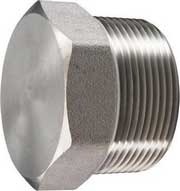
Hex head plug
A hexagonal threaded plug is used to close female threaded openings in pipes and other components.
It has a hexagonal head that can be easily gripped with a wrench or socket, as well as a male
thread that is screwed into a female thread to block the flow and prevent leaks.
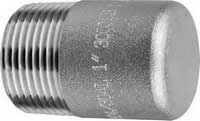
Round head plug
A threaded round head plug is used to close the end of a pipe or opening with an internal thread.
It has a round, smooth head and a threaded end that is screwed into the fitting to create a closed
connection.
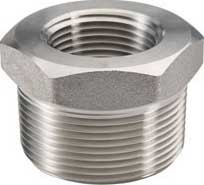
Hex head bushing
A threaded hex bushing is used to connect pipes or fittings of different sizes by reducing a larger
internal thread to a smaller one. It has a hex head for easy installation and removal with a wrench,
an external thread, and an internal thread for connecting a smaller pipe.
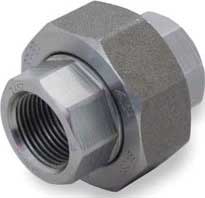
Union (MSS SP-83)
A threaded union is a three-piece pipe connection that joins two pipes together, allowing for easy
separation and reconnection without cutting or welding. It consists of two female threaded ends
and a central nut that is tightened to press the two ends together, creating a seal.

Advantages and Disadvantages of Threaded Fittings
Advantages
- Installation productivity is moderately high, and specialized installation skill requirements are not extensive.
- Leakage integrity is good for low-pressure, low-temperature installations where vibration is not encountered.
Disadvantages
- Rapid temperature changes may lead to leaks due to differential thermal expansion between the pipe and fittings.
- Vibration can result in fatigue failures of screwed pipe joints due to the high stress intensification effects caused by the sharp notches at the base of the threads.
- In hazardous piping systems threaded connections should be avoided, if possible. Their vulnerability to fatigue damage is significant, especially where exposed threads are subject to corrosion.
Remark(s) of the Author...
You knew that...?
- At the smallest sizes, the amount of wall lost during threading actually equals approximately 55% of the original pipe wall.
Related Post(s)
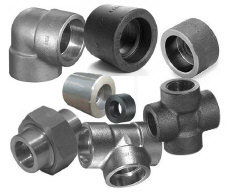
A Socket Weld is a pipe attachment detail in which a pipe is inserted into a recessed area of a valve, fitting or flange...
