
Hormuz Strait
June 2026
Remark(s) of the Author...
The Strait of Hormuz was not designed by humans, but is a natural strait formed by tectonic activity.
Therefore, no design was required, and this article does not technically fall under design, but it does fit into the waterways section of civil engineering.
Overview
The Strait of Hormuz is a narrow strait that separates the Arabian Peninsula and Iran and connects the Persian Gulf with the Gulf of Oman and the Arabian Sea. At its narrowest point, the strait is only 29 nautical miles (54 km) wide and consists of 3.7 km wide navigation channels for incoming and outgoing shipping, as well as a 3.7 km wide buffer zone.
The strait, through which an average of 20 million barrels of crude oil and oil products were transported per day in 2025, is one of the most significant bottlenecks in global oil transport. Given that approximately 25% of global oil trade passes through the strait by sea and options to bypass it are limited, any disruption to passage through the strait would have enormous consequences for global oil markets.
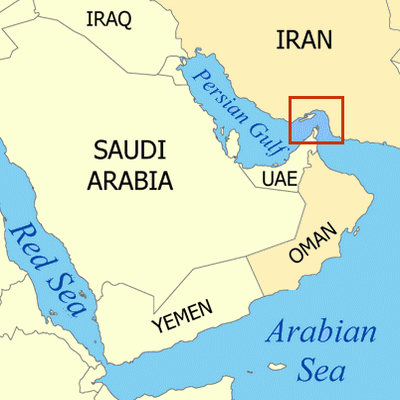
While Saudi Arabia and the United Arab Emirates (UAE) have some oil export
routes that do not transit the Strait of Hormuz, other countries including Iran, Iraq, Kuwait,
Qatar and Bahrain rely on the Strait to deliver the vast majority of their oil exports.
A closure of the Strait would also have significant implications for global gas trade, as this would
strand LNG exports from Qatar and the UAE, which together represent almost 20% of global LNG exports.
| please read the source article | |
 |
International Energy Agency |
Related Post(s)

In remembrance of Sir Mokshagundam Visvesvaraya, the most outstanding Engineer of all times, the Engineering fraternity of India celebrates “Engineer's Day” every year on 15th of September...