
 |
Weld End Preparation at Unequal Wall Thicknesses |
Acceptable Design in Piping components
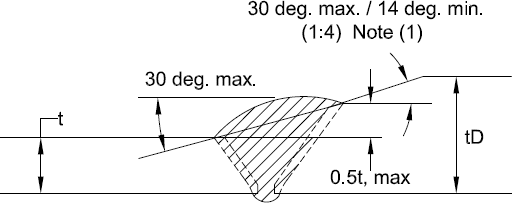
When welding components with unequal wall thicknesses, particularly those with butt-welded ends, standards such as ASME B31.3 and ASME B31.8 require that the thicker section be tapered to prevent stress concentrations and structural failure. The excess thickness must be gradually reduced on both the inside and outside to form a transition zone, rather than creating an abrupt transition.
The external surface of the heavier component is tapered at an angle of 30° maximum for a minimum length equal to 1.1/2 times the pipe minimum wall thickness and then at 45° for a minimum of 1.1/2 times the pipe minimum wall.
Internally, either a straight bore followed by a 30° slope or a taper bore at a maximum slope
of 1 to 4 for a minimum distance of 2 times the pipe minimum wall are required.
The surface of the weld can also be tapered to accommodate differing thickness. This taper should not
exceed 30°. It may be necessary to deposit weld metal to assure that these limits are not violated.
Below some examples with acceptable design for unequal wall thicknesses according to ASME B31.8
Internal Offset
A
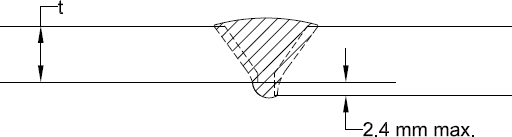
Internal Offset
B
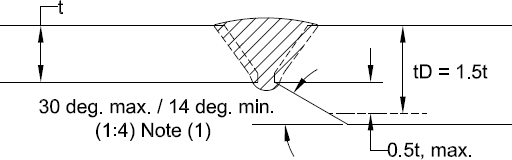
Internal Offset
C
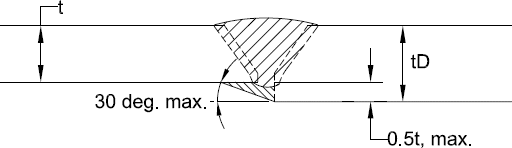
Internal Offset
D
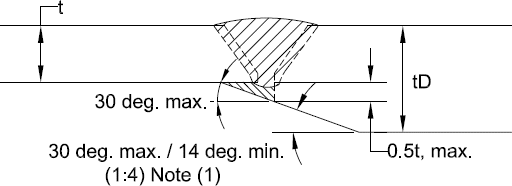
External Offset
E
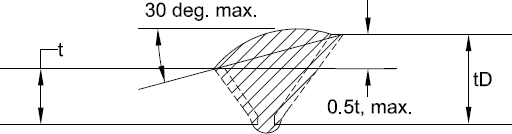
External Offset
F
Combination Offset
G
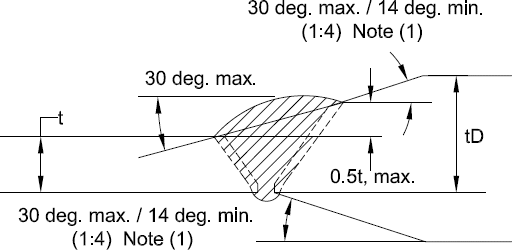
Note (1)..
No minimum when materials joined have equal specified minimum yield strengths.
Related Post(s)
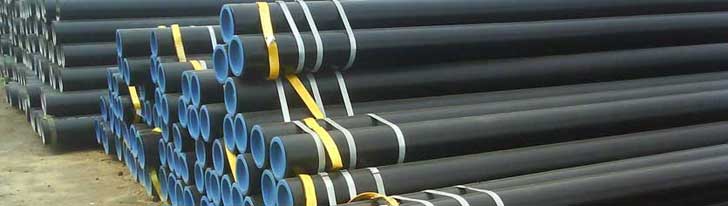
At the IPS time only three walltickness were in use. In March 1927, the American Standards Association surveyed industry and created a system that designated wall thicknesses based on smaller steps between sizes...