
 |
Centrifugal Pumps acc. API 610 standard |
The API 610 standard specifies requirements for centrifugal pumps, including pumps running in reverse as hydraulic power recovery turbines (HPRTs), for use in petroleum, petrochemical, and gas industry process services.
The three main categories of API 610 centrifugal pumps are..
OH - Overhung
BB - Between Bearing
VS - Vertically Suspended
OH – Overhung pumps – The impellers of these pumps protrude above the bearings. The support must absorb all forces, such as the overhanging mass and the dynamic and hydraulic forces of the rotor. The impellers of these pumps can be mounted either horizontally or vertically.
BB – Between bearing pumps – The impellers of BB pumps are suspended between the supports. In all pumps of this type, the impeller is positioned horizontally, in the same plane as the bearings.
VS – Vertically suspended pumps – VS pumps are supported above the medium to be pumped. The vertically oriented impellers are suspended below the support and are immersed in the medium.
The pumps described in this standard are classified and designated by type codes as shown in the Table below.

Short description of OH type pumps
Overhung (OH) pumps fall into the simplest group with a relatively low price, low
pressure, and suitability for medium-sized applications, making these pumps the most economical
choice. Their main feature is the use of a single bearing set on one side of the shaft and are divided
into six types..
OH1- OH2- OH3- OH4- OH5- OH6
API OH1 Type Pump
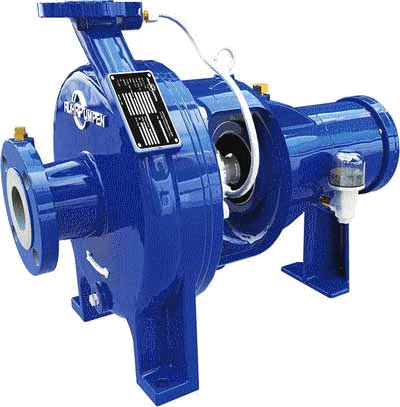
The OH1 type is a flexibly coupled horizontal pump with a foot support located between the pump casing and the motor. Due to their design, they can suffer from shaft misalignment errors and deformation of the nozzle as a result of thermal expansion.
API OH2 Type Pump
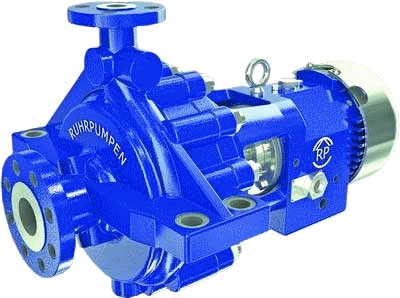
The OH2 type is a flexibly coupled, horizontal pump with central shaft support and shaft mounting, which reduces the thermal load on the shaft and nozzles at high temperatures. This minimizes the risk of shaft deflection. The minimum design pressure of OH2 pumps is 40 bar at 38 °C. Their nozzle class is typically at least pressure class 300.
API OH3 Type Pump
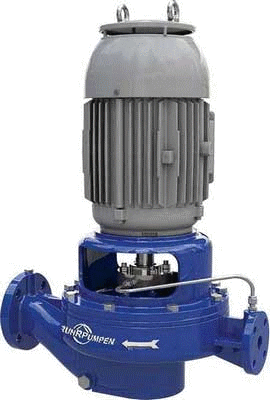
The OH3 type is a flexibly coupled, vertical inline pump with a bearing bracket. The flexible coupling allows for easier shaft alignment and protects the pump against thermal and mechanical stresses. Thanks to their simple inline configuration, these pumps are the most economical choice for non-heavy-duty applications with low head and flow rates.
API OH4 Type Pump
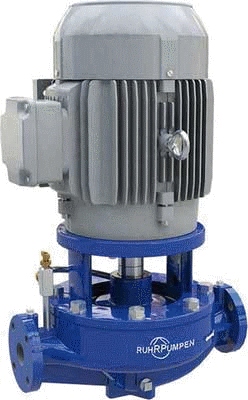
The OH4 type has rigid couplings and is a vertical in-line type. The rigid coupling makes it difficult to align the drive with the pump. Disassembly of the pump is only possible by moving the drive and the connecting pipelines.
API OH5 Type Pump
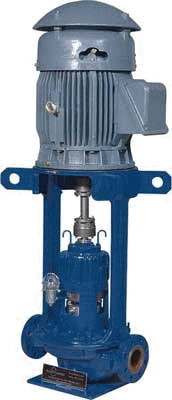
The OH5 type is a direct-coupled, vertical in-line pump. These pumps do not have a coupling for their shaft. Like OH4 pumps, the OH5 is not recommended by API 610. Compared to horizontal pumps, all vertical types (OH1, OH2, and OH3) can withstand up to twice as much load on their inlet/outlet flanges and still remain functional. These loads can result from thermal expansion or mechanical stress in the piping system.
API OH6 Type Pump
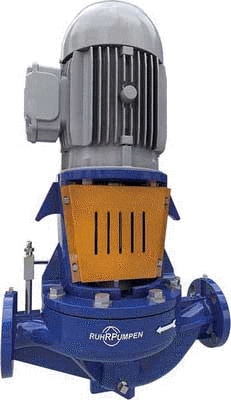
The OH6 type is a compact, fast, integrated gear pump and can deliver high pressure thanks to its high rotational speed achieved by means of an internal gear transmission. Normally, there is one coupling between the gearbox and the motor, while there is no coupling between the gearbox and the impeller.
Short description of BB type pumps
Between Bearings (BB) pumps fall into the high pressure class. The main feature of
these pumps is that the shaft is supported by two sets of bearings on either side of the impeller
and are designed in a multi-stage configuration for high pressure applications. In addition, they
can be of the double suction type if a high flow rate is required and are divided into five types..
BB1 - BB2 - BB3 - BB4 - BB5
API BB1 Type Pump
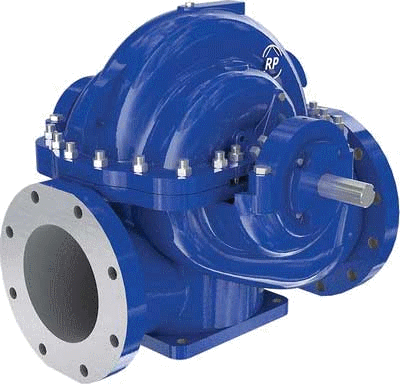
The The BB1 type typically uses a double suction impeller to balance the thrust on the shaft and reduce vibrations. Because the housing can be opened axially relative to the shaft, the internal components are easily accessible, and compared to other types, the pump impeller can handle large flow rates.
API BB2 Type Pump
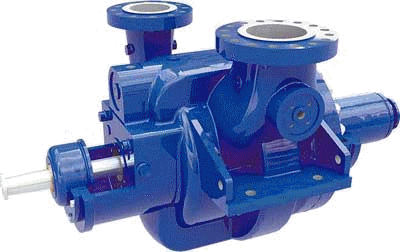
The BB2 pumps are available in single-stage and two-stage versions with radial split. The pumps offer the advantage of good sealing of the housing. They can be produced in single-stage or two-stage versions. If the inlet and outlet nozzles are aligned (without any offset) in relation to each other, the pump has a single stage.
API BB3 Type Pump
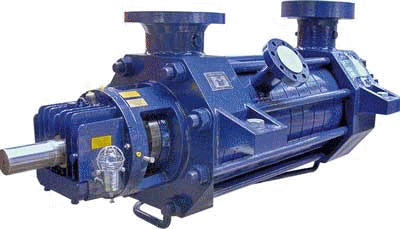
The BB3 type pump can deliver very high pressure for demanding applications such as high-pressure boilers. There is a large pressure difference between the inlet and outlet sides of these pumps, and these enormous pressure differences can lead to excessive stress on the pump. To balance the axial and radial forces on the shaft, the flow direction in half of the impellers (stages) must be opposite to that in the other half, which can be achieved by mounting the impellers in reverse direction on the shaft.
API BB4 Type Pump
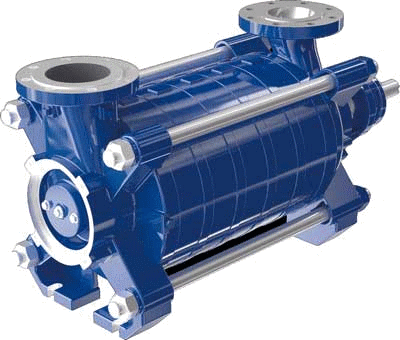
The BB4 type is a multi-stage, radially split pump with a single housing. Each stage consists of an impeller and a cylindrical housing that encloses the impeller. These housings are then connected to each other along the shaft by means of tie rods. The entire casing consists of several smaller parts that are connected to each other. This makes sealing difficult at high pressure or low viscosity, and the type does not meet all API requirements.
API BB5 Type Pump
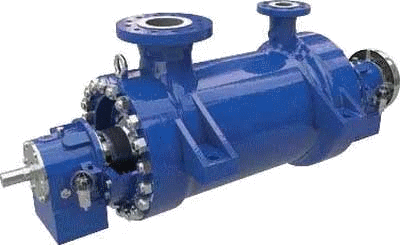
The BB5 type is a multi-stage, radially split pump with a double casing. This type is mainly used for hazardous liquids or liquids under high pressure, where leak prevention is of crucial importance. The pump consists of two casings, one inside the other, to ensure the pump is sealed, and the inner casing can be axial or radial.
Short description of VS type pumps
In this class, the impeller is suspended vertically in the liquid, usually via a
long shaft. Vertically suspended pumps are mainly used for pumping liquids from underground (well)
sources and for cryogenic applications where the available NPSH (Net Positive Suction Head) is low.
This class has a relatively limited range of applications in the oil, gas, and petrochemical industries,
and are divided into seven groups..
VS1- VS2- VS3- VS4- VS5- VS6- VS7
API VS1 Type Pump
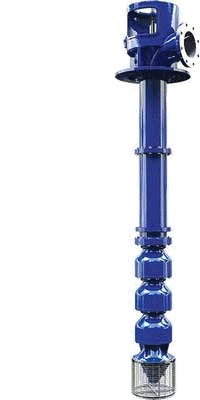
The VS1 type is a vertically suspended pump with a single pump housing, and is used as a wet pit pump or diffuser pump, where the pump column serves as a discharge for the pump.
API VS2 Type Pump
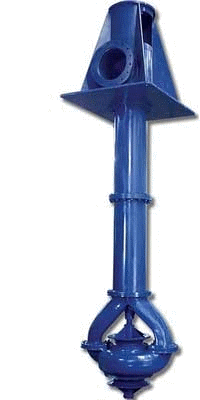
VS2 type is a single casing, discharge through column, volute pump. VS2 is mostly used for moderate flow rate and head and is highly reliable and ideal for sump applications.
API VS3 Type Pump
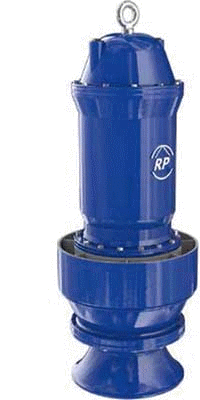
VS3 type has a axial flow and single casing vertically suspended type design. Pump column over which pump assembly is mounted, used as discharge from the pump and this type can handle large flow rate.
API VS4 Type Pump
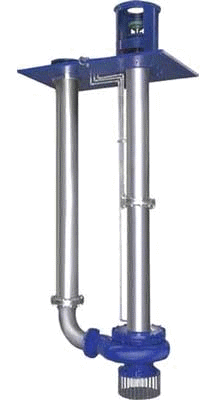
The VS4 type is a line shaft pump with a single housing and a separate discharge. It is one of the most popular vertically mounted pumps and consists of a long shaft with multiple couplings, allowing it to be used in deep wells. It has a separate discharge pipe that is not located in the center of the main section. As a result, the unbalanced radial loads can cause vibrations. VS4 contains multiple slide bearings to support the long shaft. For smooth operation, these bearings must be cooled with a flushing fluid. This fluid is usually taken from the main process fluid.
API VS5 Type Pump
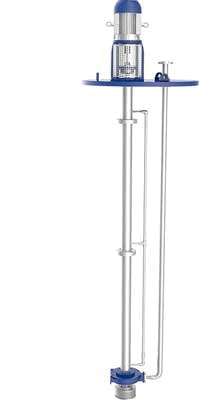
The VS5 type is a cantilever pump with a single housing and separate discharge. They are identical to VS4, except that VS5 has a rigid, one-piece shaft. Normally, they are not equipped with slide bearings and are therefore suitable for dirty applications where no external coolant is available.
API VS6 Type Pump
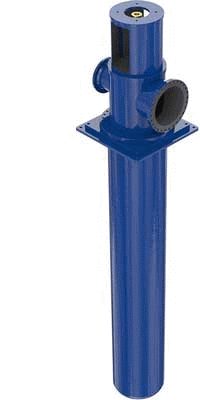
The VS6 type is a double casing, diffuser pump. It is a multistage pump with suction and discharge nozzles at same elevation. The impellers are located at lower elevation and therefore, the VS6 main advantage is that it requires lower NPSHr due to vertical fluid column at suction. This type is perfect for cryogenic services.
API VS7 Type Pump
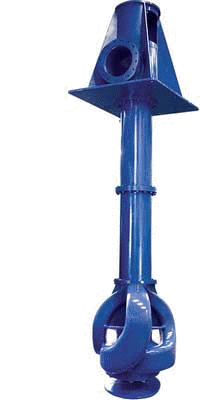
The VS7 type is a double casing, volute pump and is similar to the VS6 type, except that it is a single-stage pump and has a volute casing.
Ruhrpumpen
For highly detailed information on all API 610 pump types mentioned in this article, “Ruhrpumpen” is a reliable source, but there are of course other suppliers as well.
Related Post(s)

Cavitation in pumps is the rapid creation and subsequent disintegration of bubbles in a liquid. Bubbles may not seem very powerful, but...