|
Gaskets and Bolts for flanged connections |
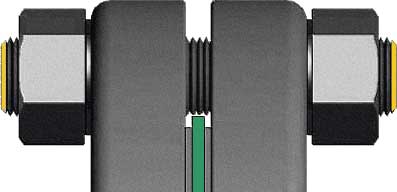
To realize a leak-free flange connection gaskets are necessary.
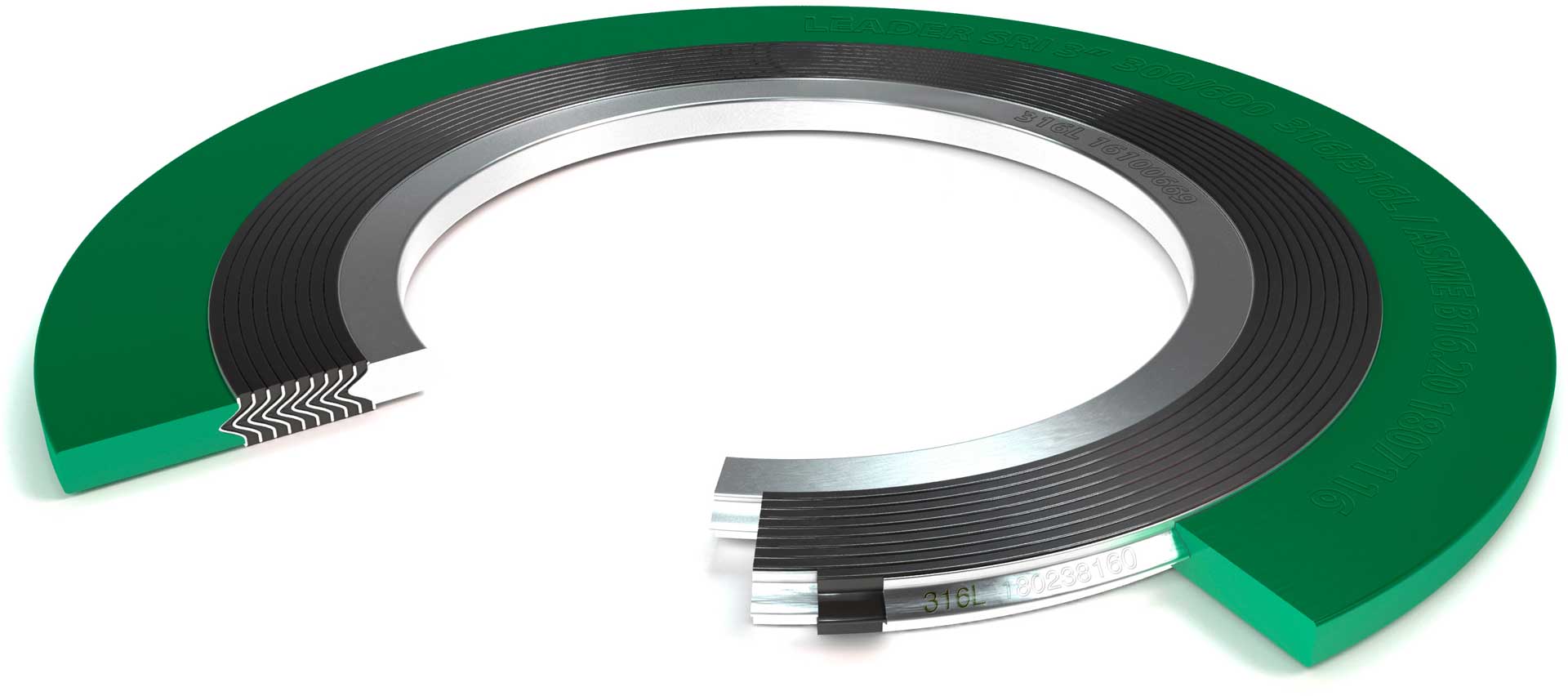
Gaskets are compressible sheets or rings used to make a fluid-resistant seal between two surfaces. Gaskets are built to operate under extreme temperature and pressures and are available in a wide range of metallic, semi-metallic and non-metallic materials.
The principle of sealing, for example, is the compression from a gasket between two flanges. A gaskets fills the microscopic spaces and irregularities of the flange faces and then it forms a seal that is designed to keep liquids and gases. Correct installation of damage free gaskets is a requirement for a leak-free flange connection.
This website describes gaskets for pipe flanges in accordance with ASME B16.20 (metal and semi-metal) and ASME B16.21 (non-metallic), as well as gaskets of different types and designs.
General
rule: the smaller the contact area between the flange faces, the harder the material of the gasket
and the flange seal must be. This is because a smaller sealing surface means that a higher pressure can
be applied with less force (pressure = force / area).
Harder materials require higher pressure to seal than softer materials, even if the surfaces have been
ground and lapped prior to assembly. To achieve higher pressures without exerting excessive torque on
the fasteners, the contact area of the sealing surface is reduced.
The Gaskets menu gives you access to all information regarding gasket types, materials, and dimensions.
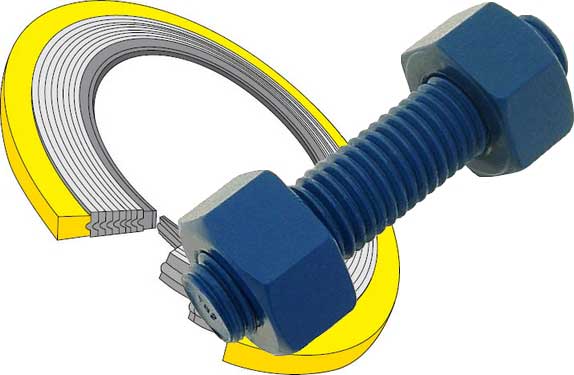
To connect two flanges with each other, also bolts are necessary.
The quantity will be given by the number of bolt holes in a flange, diameter and length of bolts is dependent of flange type and Pressure Class of flange.
The most commonly used bolts in the petrochemical industry for ASME flanges are stud bolts. Stud bolts consist of a threaded rod and are secured with a nut on each end. The other type available is the machine bolt, which is secured with a single nut. This site focuses primarily on stud bolts..
Dimensions, materials, dimensional tolerances, etc., are specified in various ASME standards, and the materials are specified in several ASTM standards.
The Bolts menu gives you access to all information regarding bolt types, materials, and dimensions.
Related Post(s)