
 |
Camprofile Gaskets |
Camprofile Gaskets, also known as grooved metal gaskets or as Kammprofile gaskets, (moreover, this website also uses CAM gaskets). The gaskets have their origins in the heat exchanger world because of their longevity and durability.
Camprofile gaskets consist of a concentrically serrated, solid metal core with a soft, formable seal material bonded to each surface. The soft facing material provides a low-stress seal, while the serrated geometry of the metal core improves the seal by causing stress concentrations on the sealing surfaces. The serrations minimize lateral movement of the facing material, while the metal core provides rigidity and impact resistance
The materials of the solid metal core are carbon steel, 304/316 stainless steel, and for higher temperatures materials such as Inconel and Hastelloy.
The facing material is often a soft surface material such as graphite and other non-asbestos filler materials include Mica (high-temperature applications), PTFE and others.

A Camprofile gasket does not need an outer or inner ring (like a spiral gasket). However, when used in a flange connection, an outer ring is recommended, because that outer ring helps, during assembly, to easily center the gasket between the flange bolts. The facing material is usually graphite, when used for petrochemical applications.
Note: The outer ring (guide ring) may be loose (see profile P3 below), allowing the solid metal core of the gasket to grow during thermal expansion,
Common Camprofile profiles
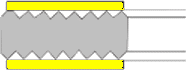
Ideal for use in tight spaces, including male and female tongue and groove connections and recessed flange types. These gaskets easily replace jacket gaskets on heat exchangers, as they seal and fit better. Recommended for complex shapes.
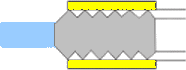
The outer centering ring allows the gasket to be properly placed in the flange joint. Recommended for use on standard flanges with raised or flat surfaces.
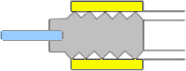
Is often preferred where there may be radial thermal expansion of the flange joint. The separate outer centering ring, which can also be tack welded, reduces the cost of the gasket because it can be made of less expensive material (e.g., carbon steel).
Strengths of a Camprofile Gasket
Camprofile gaskets are well suited for heat exchangers and other flange connections. They are tough, difficult to break during assembly, they operate at high temperatures and pressures and can handle large bolt loads.
Weaknesses of Camprofile Gaskets
One diadvantage of these gaskets is that they are hard and more sensitive to flange surface imperfections.
The flange sealing surface may have minimal dents and scratches and must meet ASME PCC-1 Appendix D standard for flatness tolerances for flange surfaces.
Remark(s) of the Author...
Together with my colleagues we conducted a test with two flange connections, each NPS 16 CLASS 300,
in a carbon steel pipeline, on which a hydrotest had to be conducted under the same conditions.
A Spiral Wound gasket was installed in the first flange connection and a Camprofile gasket in the second.
Both joints were completely acceptable after the test, as no leakage was detected.
So, what is so special about this?
Both flange connections were torqued with professional equipment and new stud bolts were used.
Exact torque values cannot be given here, but for the flange connection with the CAM gasket, significantly
less force was needed for the leak-free flange connection.
At that moment I was quite surprised, and only later I realized “how is this possible?”.
Differences between.. spw & cam
Related Post(s)

Dimensions of Grooved (Camprofile) Gaskets ASME B16.20 used with Raised Face flanges ASME B16.5...