|
Stainless Steel ‑ the beginning |
Harry Brearley of Sheffield, England, achieved fame as a metallurgist when he discovered stainless steel in 1913. Working in his own laboratory, he discovered that adding a certain percentage of chromium to molten iron produced a metal that did not rust, paving the way for stainless steel.
Contrary to popular belief, stainless steel is not a single alloy, but a large family of iron alloys containing at least 10.5% chromium. Today, there are many different types of stainless steel used for a wide variety of applications.
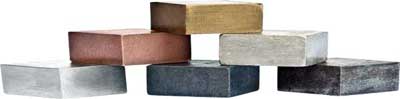
While different types of stainless steel may differ in their metallurgical composition, alloy, or manufacturing processes, they all share one common characteristic: a passivation layer.
This layer of chromium oxide forms when the metal surface is exposed to oxygen.
The layer is too thin to be directly visible and remains transparent under most conditions. This allows the final texture of a stainless steel product to be visible and allows for a variety of finishes.
The passivation layer is waterproof, forms naturally, and protects the metal. Although the layer may discolor under extreme temperatures, it continues to perform its function.
However, stainless steel is not indestructible. Under certain conditions, it can still corrode.
While stainless steel shares several properties, it's essential to understand the different types available to find the optimal one for your needs.
Thanks to its versatility, durability, and affordability, stainless steel production continues to increase worldwide year after year.
However, stainless steel is not a homogeneous alloy.
While stainless steel owes much of its corrosion resistance to chromium, numerous combinations of different metals are now sold as stainless steel.
One of the first steps in finding the best stainless steel options is determining the right alloy for the product.
Most stainless steel alloys have two main designations
A lot can be learned from these two designations, if you know what to look for.
Families refer to specific properties and provide an idea of the ratio of different metals in the alloy.
Stainless steel falls into four different families..
But the family is only part of the story. To truly understand what distinguishes one type of stainless steel from another, the quality must be considered.
Within alloy families, there are various quality classes that describe specific properties of the alloy, such as ductility, magnetism, corrosion resistance, and alloy composition.
This family is the most popular and widely used in the world.
It often contains chromium and nickel, and some grades also contain manganese and molybdenum.
Although austenitic stainless steel is non-magnetic after solution annealing, certain cold-worked grades are magnetic. Heat hardening is not effective with these steels.
However, they offer excellent corrosion and creep resistance and are also very suitable for welding.
The table below eighteen commonly used austenitic stainless steelsstandards
| Grade | Composition | Key Features |
| Type 304 | 18% Cr, 8% Ni, 0.1% C | Workhorse grade, excellent general-purpose corrosion resistance |
| Type 304L | 18% Cr, 8% Ni, 0.03% C | Low-carbon version prevents sensitization during welding |
| Type 321 | 18% Cr, 8% Ni, 0.1% C + Titanium (10× carbon) | Stabilized with titanium, workhorse of intermediate temperature materials, prevents intergranular corrosion |
| Type 347 | 18% Cr, 8% Ni, 0.1% C + Niobium/Columbium | Stabilized with niobium, excellent for high-temperature service |
| Type 348 | 18% Cr, 8% Ni, 0.1% C + Cb + Nb | Stabilized steel for demanding applications |
| Type 316 | 18% Cr, 8% Ni, 0.15% C + 2% Mo | Enhanced corrosion resistance, especially against chlorides and acids |
| Type 317 | 18% Cr, 8% Ni, 0.1% C + 4% Mo | Superior resistance to pitting and crevice corrosion |
| Type 308 | 19% Cr, 9% Ni, 0.1% C | For high-temperature applications |
| Type 309 | 20% Cr, 12% Ni, 0.1% C | Enhanced high-temperature oxidation resistance |
| Type 310 | 25% Cr, 14% Ni, 0.1% C | Exceptional high-temperature applications up to 2000°F |
The lower nickel content makes this one of the most cost-effective alloys available.
Although low in nickel, these alloys often contain chromium, molybdenum, niobium, and/or titanium to improve toughness and creep resistance.
Most are magnetic and offer good corrosion resistance and weldability and they are well-suited for situations where aesthetics are less important than cost and performance.
This family includes many of the latest and patented alloys.
Many duplex alloys offer a combination of the properties of both austenitic and ferritic stainless steels.
The properties depend on the alloy, as many alloys are developed to meet specific industrial requirements, such as weight, toughness, and higher tensile strength. Most offer good weldability and formability compared to other steel families.
Although martensitic and precipitation-hardened steels are the least common of the four major stainless steel families, they are popular in applications requiring a precise, hardened edge.
The addition of carbon allows for tempering and hardening, making this family a leading choice for knives, scissors, razors, and medical instruments.
These stainless steel alloys offer moderate to good corrosion resistance and remain magnetic after hardening.

Older quality classes often have a three-digit identification code established by the Society of Automotive Engineers (SAE).
However, in North America, you may also encounter quality classes designated by a six-digit identification code established by the American Society for Testing and Materials (ASTM). These are known as Unified Number System (UNS) identifiers (list of these commonly used identifiers).
In many cases, UNS identification numbers share the same first three digits as their AISI (American Iron and Steel Institute) equivalents.
However, classification systems have also been developed by..
The large number of different standards and classification systems can make it difficult to obtain detailed information about the unique composition of a particular alloy based on its classification.
Successful stainless steel selection requires an understanding of the workings of various corrosion mechanisms. Each type of corrosion presents unique challenges and requires specific metallurgical solutions.
General corrosion corrosion resistance of a particular stainless steel depends on its constituent elements, meaning each grade reacts slightly differently to a corrosive environment. Therefore, it's important to choose the most suitable stainless steel grade for a specific application. In addition to careful material selection, good detailing and craftsmanship can significantly reduce the risk of staining and corrosion.
Pitting corrosion is a localized form of corrosion that can occur as a result of exposure to specific environments, particularly those containing chlorides. In most structural applications, the degree of pitting is likely to be superficial, and the reduction in a component's cross-sectional area is negligible. However, corrosion products can damage architectural elements. A less tolerant approach to pitting should be adopted for installations such as ducts, pipes, and storage structures. If there is a known risk of pitting corrosion, a molybdenum-containing stainless steel is required.
Crevice corrosion is a localized form of corrosion caused by the extremely low availability of oxygen in a crevice. It is only a problem in stagnant fluids where chlorides can accumulate. The severity of crevice corrosion depends heavily on the shape of the crevice; the narrower (approximately 25 microns) and deeper the crevice, the more severe the corrosion. Crevices typically occur between nuts and washers, or around the threads of a screw or the shank of a bolt. Crevices can also occur in welds that do not fully penetrate, and beneath deposits on the steel surface.
Bimetallic (galvanic) corrosion can occur when dissimilar metals come into contact with each other in a common electrolyte (e.g., rain, condensation, etc.). When current flows between the two, the less noble metal (the anode) corrodes faster than if the metals were not in contact.
Stress corrosion cracking (SCC) requires the simultaneous presence of tensile stresses and specific environmental conditions. It rarely occurs in normal building environments. The stresses do not necessarily have to be very high relative to the material's yield point and can result from loading and/or residual effects of manufacturing processes such as welding or bending. Caution is advised when using stainless steel components with high residual stresses (e.g., due to cold working) in chloride-rich environments (e.g., swimming pool enclosures, marine applications, offshore).
Conclusion from decorative structures to robust industrial use, stainless steel offers a wide range of applications. Understanding the unique properties of different stainless steel alloys is essential to not only ensure longevity and safe operation, but also to optimize costs.
Conclusion from decorative structures to robust industrial use, stainless steel offers a wide range of applications. Understanding the unique properties of different stainless steel alloys is essential to not only ensure longevity and safe operation, but also to optimize costs.
Reference(s)..
www.unifiedalloys.com
bssa.org.uk
www.sheffieldmuseums.org.uk
Related Post(s)