
 |
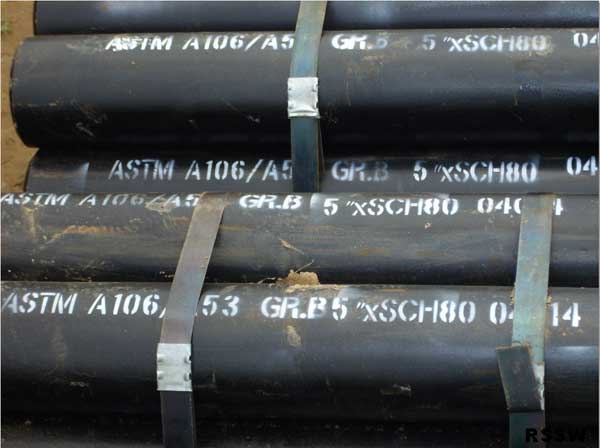
ASTM A106 Pipe Material Specification |
ASTM A106 covers seamless carbon steel pipe for high-temperature service in NPS 1/8 to NPS 48
ASTM A106 shall be permissible to furnish pipe having other dimensions provided such pipe complies with all other requirements of the ASTM A106 standard. Pipe ordered under that standard shall be suitable for bending, flanging, and similar forming operations, and for welding.
For pipes of NPS 1.1/2 and below, delivery of hot-rolled or cold-drawn pipes is permitted. Unless otherwise stated, pipes of NPS 2 and above shall be hot-rolled pipes. If agreed between the manufacturer and the purchaser, delivery of cold-drawn pipes is permitted.
Seamless pressure pipes of type ASTM A106 are widely used in the construction of oil and gas refineries, power plants, petrochemical plants and steam boilers, where the pipes have to transport liquids and gases at higher temperatures and pressures.

Process
The steel shall be killed steel, where the primary melting process is open hearth, basic oxygen or electric, possibly combined with a separate degassing or refining. If secondary melting is then used, using electroslag remelting or vacuum arc remelting, the heat is defined as all ingots remelted with one primary heat source.
Heat treatment
Hot rolled pipes do not need to be heat treated. When hot rolled pipes are heat treated, they must be treated at a temperature of 650 °C or higher. Cold drawn pipes must be heat treated at a temperature of 650 °C or higher after the final cold drawing stage.
Chemical composition
The steel must meet the chemical composition requirements as prescribed in the table below.
| | Grade A | Grade B | Grade C |
| Carbon max% | 0.25 | 0.30* | 0.35* |
| *Manganese % | 0.27 to 0.93 | *0.29 to 1.06 | *0.29 to 1.06 |
| Phosphorous, max% | 0.035 | 0.035 | 0.035 |
| Sulfur, max% | 0.035 | 0.035 | 0.035 |
| Silicon, min.% | 0.10 | 0.10 | 0.10 |
| Chrome, max% | 0.40 | 0.40 | 0.40 |
| Copper, max% | 0.40 | 0.40 | 0.40 |
| Molybdenum, max% | 0.15 | 0.15 | 0.15 |
| Nickel, max% | 0.40 | 0.40 | 0.40 |
| Vanadium, max% | 0.08 | 0.08 | 0.08 |
| *Unless otherwise specified by the purchaser, for each reduction of 0.01% below the specified carbon maximum, an increase of 0.06% manganese above the specified maximum will be permitted up to a maximum of 1.65% (1.35% for ASME A106). | |||
Tensile Requirements Seamless Pipe
| | Grade A | Grade B | Grade C |
| Tensile Strength, min., psi | 48,000 | 60,000 | 70,000 |
| Yield Strength, min., psi | 30,000 | 35,000 | 40,000 |
Required on all sizes
Hydrostatic Testing
Each length of pipe shall be subjected to a hydrostatic test without leakage through the pipe wall. In some cases it is permissible to test the entire pipe with a non-destructive electrical test.
Lengths
Pipe lengths shall conform to the following common practice:If fixed lengths are not required, pipes may be ordered in single random lengths or double random lengths that meet the following requirements:
- Single random lengths shall be 16 to 22 ft (4.8 to 6.7 m) long
- Double random lengths shall have a minimum average length of 35 ft (10.7 m) and a minimum length of 22 ft (6.7 m).
Permissible Variations Outside Diameter
| NPS 1/8-NPS 24STD-XS-XXS ASME B36.10 Other sizes and dimensions may be furnished |
||
| NPS | Over | Under |
| 1/8 to 1-1/2, incl Over 1-1/2 to 4, incl Over 4 to 8, incl Over 8 to 18, incl Over 18 to 26, incl |
1/64 1/32 1/16 3/32 1/8 |
1/64 1/32 1/32 1/32 1/32 |
Permissible Variations in Wall Thickness
Minimum wall thickness at any point shall not be more than 12.5 percent under nominal wall thickness specified. Specification contains a table of minimum wall thicknesses on inspection calculated as 0.875 x nominal wall.
Permissible Variations in Weights per Foot
Pipe shall not vary more than 6.5 percent over and 3.5 percent under weights shown in ASME B36.10. Sizes NPS 4 and smaller are weighed in convenient lots. Pipe in sizes larger than NPS 4 is weighed separately.
Mechanical Tests Specified
Bend test
Required for sizes 2 inches and smaller. Pipe shall withstand cold bending of 90 degrees around a mandrel twelve times the nominal diameter of the pipe without cracking. When tightly wound, the bending should be 180 degrees around a mandrel eight times the nominal diameter of the pipe.
Referenced Documents
ASTM Standards
- A530 Specification for General Requirements for Specialized Carbon and Alloy Steel Pipe
- E213 Practice for Ultrasonic Testing of Metal Pipe and Tubing
- E309 Practice for Eddy Current Examination of Steel Tubular Products Using Magnetic Saturation
- E381 Method of Macroetch Testing Steel Bars, Billets,Blooms, and Forgings
- E570 Practice for Flux Leakage Examination of Ferromagnetic Steel Tubular Products
ASME Standard
- B 36.10 Welded and SeamlessWrought Steel Pipe
Frequently used ASTM Grades
| Material | Pipes | Fittings | Flanges | Valves | Bolts & Nuts |
| Carbon Steel | A106 Gr.A |
A234 Gr.WPA |
A105 | A216 Gr.WCB |
A193 Gr.B7 A194 Gr.2H |
| A106 Gr.B |
A234 Gr.WPB |
A105 | A216 Gr.WCB |
||
| A106 Gr.C |
A234 Gr.WPC |
A105 | A216 Gr.WCB |
||
Related Post(s)
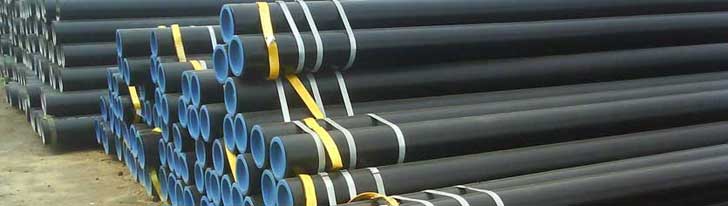
Pipes are hollow tubes with a round cross-section for transporting products such as liquids, gas, pellets, powders and more...