|
Vacuum Insulated Pipes (VIP) |
Vacuum-insulated pipes are highly efficient piping systems designed to minimize heat transfer, particularly for transporting cryogenic liquids such as hydrogen, oxygen, liquid nitrogen, or LNG and natural gas at extremely low temperatures.
This technology is based on an inner and outer pipe made of stainless steel,
between which super-insulating layers and a static vacuum barrier are installed.
A vacuum-insulated piping system may be the best option for companies that want to make their processes
more efficient.
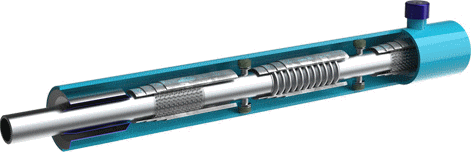
Standard vacuum-insulated pipes consist of two concentric stainless steel pipes, separated by alternating layers of heat barriers and non‑conductive spacers.
These layers are contained within a vacuum that is “pumped out” to prevent heat transfer by conduction and convection. A getter material further protects the vacuum by trapping released gas molecules, thereby maintaining insulation performance. This robust design forms the basis for the reliability of these pipes in demanding cryogenic environments.
Getter material is defined as a material placed in a vacuum device for the removal of gas by sorption.
The vacuum barrier in this type of piping virtually eliminates heat absorption by removing the medium through which thermal energy is transferred. Multiple layers of microporous super insulation provide additional resistance to heat transfer by radiation, resulting in thermal performance that is far superior to that of conventional foam systems.
This allows heat input to be significantly reduced, which translates into lower cooling loads and lower energy consumption. This level of thermal control is almost indispensable for applications that require strict temperature control.
Cryogenic temperatures cause significant shrinkage in the inner pipes, requiring technical solutions to control mechanical stress. Expansion joints, both external and internal, allow for controlled movement, maintaining the integrity of the pipes and preventing misalignment or thermal fatigue. These compensation devices are tailored to the design pressure and operating cycles, ensuring that the pipe remains leak‑free under varying temperature conditions.
Vacuum-insulated pipelines are frequently used in sectors where precise temperature control is
essential and where cold liquefied gases must be transported safely and with minimal energy loss.
This is crucial in many industries, such as:
Transporting cryogenic fluids requires compliance with strict safety standards and regulations.
Vacuum-insulated piping systems are designed in accordance with standards such as ASME Section VIII Division 1, ensuring mechanical integrity at low temperatures.
In addition, pressure relief valves and hard-wearing metal vacuum enclosures are essential to minimize the risks associated with handling cryogenic fluids.
Integrating these into the system design supports regulatory compliance and reduces the risk of hazardous incidents.
Related Post(s)