|
Deluge system |
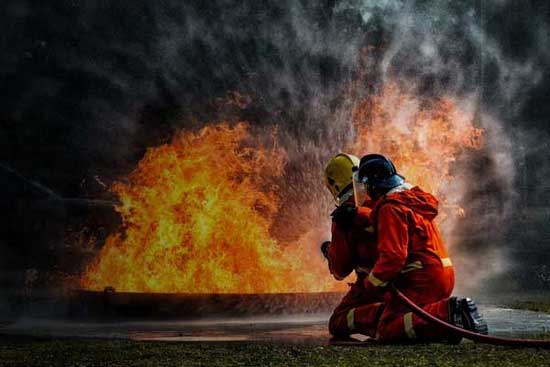
A Deluge system is a specialized fire protection system designed to quickly suppress, control, or extinguish fires by distributing a large amount of water or special extinguishing agents over a large area.
Unlike traditional sprinkler systems, which only spray water from specific sprinkler heads, Deluge systems use open nozzles that remain continuously open and are activated simultaneously upon fire detection.

 Rapid
Fire Suppression: The primary function of Deluge Systems is to provide rapid and extensive
fire suppression capabilities, covering large areas with a deluge of water or firefighting agents.
By flooding the affected area with a high volume of suppressant, these systems quickly extinguish
flames and prevent fire spread.
Rapid
Fire Suppression: The primary function of Deluge Systems is to provide rapid and extensive
fire suppression capabilities, covering large areas with a deluge of water or firefighting agents.
By flooding the affected area with a high volume of suppressant, these systems quickly extinguish
flames and prevent fire spread.
Protection
of hazardous environments: Deluge systems are particularly suitable for the protection of highly
hazardous environments, such as chemical plants, oil refineries, and storage facilities for flammable
liquids or gases. By rapidly flooding these areas with water or extinguishing agents, extinguishing
systems reduce the risk of catastrophic fires and prevent hazardous substances from entering the
environment.
Cooling
effect: Deluge systems help lower the temperature of the fire and surrounding surfaces by delivering
a continuous flow of water or special extinguishing agents. This rapid cooling effect helps prevent
re-ignition of flammable materials and limits the spread of the fire to adjacent areas.
Activation
upon detection: Deluge systems are activated automatically upon detection of fire or manually
by operators in emergency situations. As soon as the system is activated, it simultaneously sprays
water or extinguishing agents through all open nozzles, ensuring rapid and complete fire suppression.
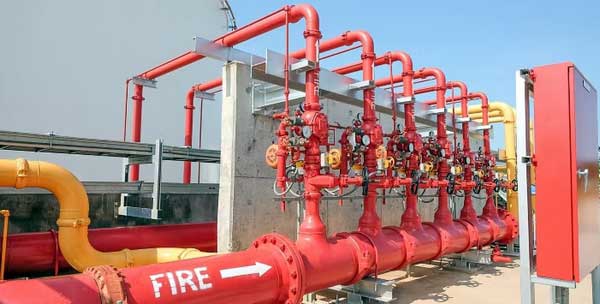 Example
of Deluge system
Example
of Deluge system Deluge
valves: form the heart of the system and regulate the water flow to all open spray nozzles.
Available with pneumatic, hydraulic, or electric operation.
Open sprinkler heads: specially designed open sprinkler heads that ensure optimal water distribution for effective fire fighting and are available in various spray patterns.
Detection
Systems: consist of advanced fire detection components that activate the Deluge system, including
smoke, heat, and flame detectors.
Piping
network: made of steel pipes with appropriate suspension brackets and supports, and drain and
test connections designed to handle high water pressure and volumes for effective fire fighting.
Control
panels: are centralized control and monitoring systems equipped with manual activation buttons
and alarm and system status indicators for operating the Deluge valve.
Water
supply: an adequate water supply system, consisting of fire pumps and water tanks, is indispensable
to guarantee the reliable operation of the Deluge system. Depending on the area to be protected,
an open-air water reservoir is often used instead of tanks, in which enormous quantities of water
can be stored.
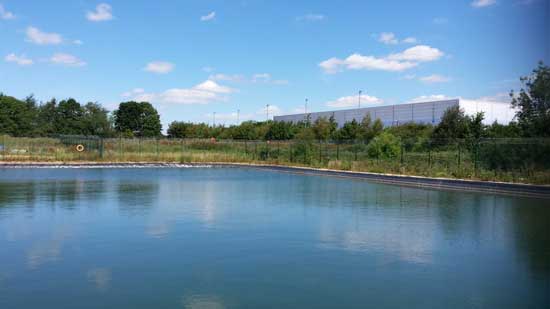 Fire
water storage
Fire
water storage Water
Deluge Systems
Water Deluge systems are the most common type of sprinkler system used in industrial environments. These systems operate with a network of open sprinklers connected to a water source, as described above.
Upon activation, the system simultaneously sprays a large amount of water through all the sprinklers, flooding the area to be protected and extinguishing the fire.
Foam
Deluge Systems
Foam Deluge systems are specialized fire protection systems designed to combat fires involving flammable liquids and hazardous substances.
These systems are commonly used in industries dealing with flammable liquids, such as petrochemical facilities, refineries, and fuel storage terminals.
Gas
Deluge Systems
Gas Deluge systems use special gases, such as carbon dioxide (CO2) or inert gases like nitrogen or argon, to extinguish fires by displacing oxygen and stopping the combustion process.
These systems are commonly used in server rooms, control rooms, and electrical substations, where water-based suppression methods could cause damage to equipment.
In summary.. The advantages of deluge
systems should be clear, as they bring rapidly spreading fires under control relatively easily,
they respond very quickly because all sprinklers are open, and operation can be fully automated.
Because Deluge systems are dry systems, there is no risk of frozen pipes or other components, and
they can be used in combination with foam concentrate or a gas mixture for better control of certain
types of fires.
Regarding materials for Deluge systems, a wide selection is available. All steel pipes and fittings
described on this website can be used, whether painted, made of stainless steel, or galvanized.
However, for piping systems in Deluges, components from, for example, Victaulic are
often used. There are also various standards for Deluge systems, as described in NFPA and others.
Related Post(s)