|
External corrosion |
Pipelines and pipeline systems are typically used to transport liquids and other substances and the most of them are susceptible to corrosion, which shortens their service life and can lead to serious system failures.
Corrosion, in both pipelines and pipeline systems is basically divided into internal and external corrosion, where internal corrosion is caused by the transport of the medium, and external corrosion by the environment and thermal effects.
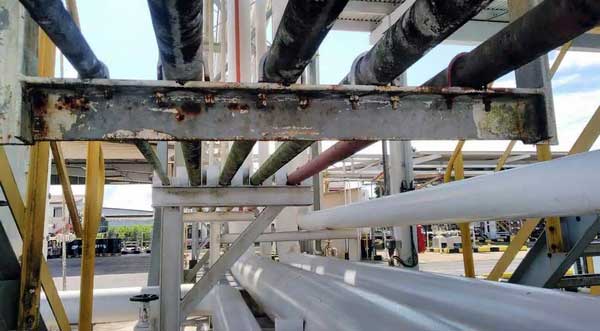
Pipeline systems are generally designed for a service life of approximately 25 years. To ensure that the pipeline system functions reliably throughout its service life, it must be protected against corrosion. There are limited options for reducing the degree of external corrosion. A frequent and perhaps most common situation is described in this article.
Internal corrosion is compensated for during the design phase by applying extra wall thickness (corrosion allowance) or by applying an internal coating that is resistant to the medium being transported.
External corrosion of pipelines and piping systems is often underestimated, leading to significant damage in many invisible places. This article describes how to reduce external corrosion of pipelines and piping systems.
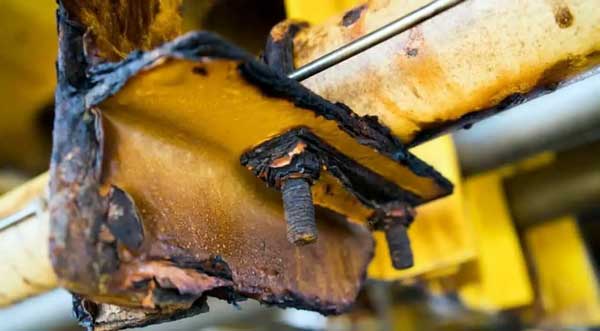
A common corrosion problem under pipe supports can be found in pipe racks, where long lengths of pipe lie on support beams and are secured with U-bolts. The painted pipes often lie directly on a painted steel beam without any further protection.
During expansion of the pipe and the steel structure, friction occurs between the two, which over time causes bare spots to appear. These bare spots under the pipe and on the top of the steel will rust quickly, depending on atmospheric conditions (the image below shows an example of this situation).

What is also noticeable in the image is that the U-bolt is also not protected and will also cause damage to the pipe over time.
Several commercial solutions exist to solve this corrosion problem, but an “old-fashioned method” is described here.
This old-fashioned method works as follows:
The pipe and the steel section are then protected, and this solution effectively accommodates expansion and contraction of both.
The image below shows the same solution as described above, except that the U-bolt is covered with a protective sleeve, and the pipe is not wrapped.
The strip that needs to be placed under the pipe is semicircular for better drainage and has two holes through which the U-bolt can be inserted, preventing it from shifting.

Image is property of: stoprust.com
The image below shows a pipe where the strip consists of a saddle attached to the pipe with two straps. The material is a high-strength composite and protects the steel structure and the pipe.

This is the so-called SmartPad system and has been in use at installations near the Gulf of Mexico since 2018. Currently, several major customers are implementing the system in pilot programs, both for evaluation purposes and for full-scale implementation.
Image is property of: cogbillconstruction.com
Solving corrosion usually involves protection or inspection and repair. Inspection can be costly, while repair often involves shutting down pipelines and poses safety risks, in addition to the actual cost of the repair itself. Proper protection prevents this problem before it occurs. Over the past few decades, numerous solutions have been developed to protect both internal and external piping systems against corrosion, with varying degrees of success.

Related Post(s)