|
UNP, UPE, Tee and Angle Profiles used in steel structures |
The areas of application for all of the above profiles are very diverse. The petrochemical industry is a major customer for the manufacture of pipe supports and many other applications, but they are also used in construction for storage racks and bulk shelving, etc.
Foreword: A
section greater than or equal to 100mm is (unofficially) called a beam, while smaller dimensions
are still called profile steel or steel section.
If anyone reads this article and has a valid explanation for the
above statement, please let me know.
UNP and UPE Europrofiles are manufactured by hot rolling of high-quality steel or specific alloys, ensuring excellent strength and durability. The material used can vary depending on the specific requirements of the project.


U.. beams are used to support metal structures in buildings, floor structures, supporting elements in civil engineering projects, including foundations and load-bearing structures, and in many industrial installations where their stability and functionality are decisive factors.
The main difference is that UNP steel beams have tapered flanges, while UPE beams have parallel flanges.
The differences are that UPE beams are generally lighter, have a better strength-to-weight ratio, and are easier to assemble because the parallel flanges simplify connections. UPN beams are heavier and have a lower load-bearing capacity per unit weight, but can be a more cost-effective option in some situations.
Steel T-beams are used less frequently in construction than other structural profiles, but when used correctly, they can offer certain advantages.
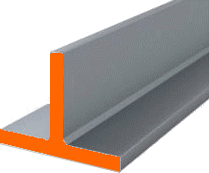
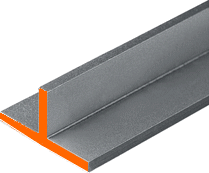
A T-beam is a steel profile that is not usually manufactured in the factory. Factories only produce small sizes. Larger steel T-beams are produced by splitting beams, usually wide-flange beams, but sometimes also I-beams.
In general, the split is made in the middle of the beam, creating an equal profile. However, the split can also be made off-center, creating an unequal profile.
Steel angle profiles, also known as angle iron, owe their name to their shape. Steel angle profiles have two flat surfaces that are perpendicular to each other and offer good resistance to bending in all directions.
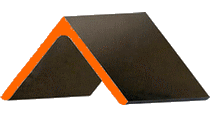
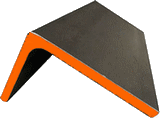
Steel angles are one of the most common forms of structural steel and are widely used in construction and building. They are available as equal angles, where both legs are the same size, and as unequal angles, where the legs are different sizes.
Other steel profiles noted on this website include round steel, square steel, and flat steel, which are not discussed further in this article. These profiles are also commonly found in steel structures, pipe supports, and many other contexts where steel is used or required.
The references below show the dimensions and weights of carbon steel profiles according to NEN-EN 10025-1/2

Related Post(s)