|
Ring Type Joint (RTJ) Gaskets |
Ring-Joint (RTJ) gaskets are made from metallic materials. The requirements in terms of dimensional accuracy and surface quality are therefore high. This applies to both the gasket and the sealing section of the flange. The required surface quality depends to a large extent on the Brinell hardness of the gasket material.
Ring joint gaskets are widely used in onshore and offshore upstream and downstream petroleum and petrochemical applications where high pressures and temperatures occur. Ring joint gaskets are manufactured in accordance with ASME B16.20 and API 6A standards.
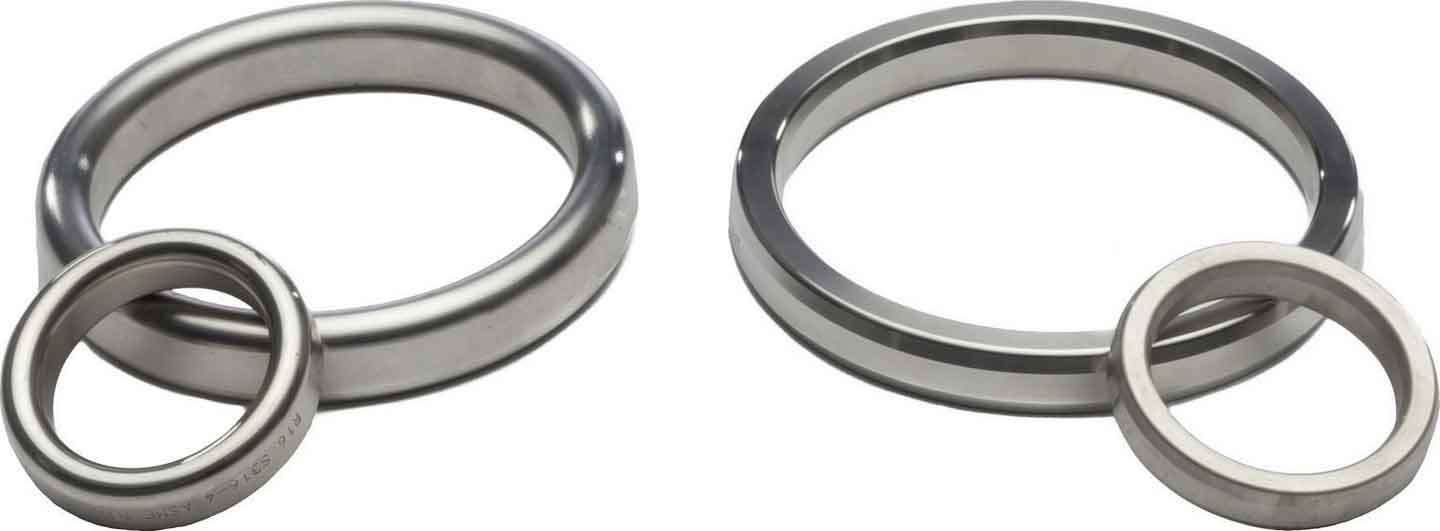
There are three types of ring-shaped gasket designs:
the R-type, the RX-type, and the BX-type.
The sealing surfaces on the grooves of the ring joint must have a smooth surface finish and must
not have any irregularities of any kind. The hardness of the ring must always be 15 to 20 HB
(Brinell Hardness) lower than the hardness of the flange groove to prevent deformation of the
flange and to allow the gasket to flow plastically into the flange surfaces.
| Material | Maximum Hardness BRINELL (BHN) |
| Soft Iron UNS - |
90 |
| Carbon and Low Alloys UNS - |
120 |
| 4–6% Chrome 1/2% Moly (F5) UNS K42544 |
130 |
| AISI 304 UNS S30400 |
160 |
| AISI 316 UNS S31600 |
160 |
| AISI 347 UNS S34700 |
160 |
| AISI 410 UNS S41000 |
170 |
| Alloy 600 UNS N06600 |
200 |
| Material | Maximum Hardness BRINELL (BHN) |
| Alloy 625 UNS N06625 |
200 |
| Alloy 800 UNS N08800 |
200 |
| Alloy 825 UNS N08825 |
200 |
| Alloy C276 UNS N10276 |
200 |
| SMO 254 UNS S31254 |
180 |
| Duplex UNS S31803 |
250 |
| Super Duplex UNS S32760 |
200 |
| Monel® 400 (M400) UNS N04400 |
200 |
| Titanium Gr.2 UNS R50400 |
215 |
With the right choice of materials, ring-shaped gaskets can withstand high pressures, temperatures, and aggressive fluids. It is important that the flange grooves and ring gaskets are properly aligned to create a good seal throughout the entire operating cycle. The surface finish of the gasket and flange, dimensional accuracy, and hardness of the gasket must be carefully checked to achieve and maintain an effective seal. The minimum hardness requirements for gaskets are listed in API 6A standard.
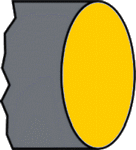
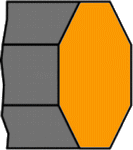
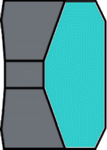
R-type gaskets are suitable for use with flanges manufactured in accordance with ASME B16.5, ASME B16.47 series A, and API 6A standards. R-type gaskets are designed for flanges with standard ring grooves and are the most commonly used type. They are available in oval and octagonal versions and are used to seal pressures up to 5000 psi. The octagonal cross-section has better sealing properties than the oval cross-section and is therefore preferred. Both oval and octagonal gaskets fit into octagonal flanges with grooves.
RX-type gaskets are pressure-activated ring gaskets designed to utilize line pressure for improved sealing. They are used for pressures up to 5000 psi (34.37 MPa) in accordance with API 6A for use with API 6B flanges. RX-type gaskets are similar in shape to the standard octagonal R-type gasket, but have an asymmetrical octagonal cross-section. Both octagonal R-type and RX-type gaskets use the same groove design, but replacing them one-for-one is not recommended, partly because some dimensions may not match.
The cross-section of RX gaskets is designed to use the existing fluid pressure for optimal sealing. The outer sealing surface of the gasket makes first contact with the flange. As the internal pressure increases, the contact pressure between the gasket and the flange also increases, improving the sealing properties of the gasket. This design makes RX gaskets more resistant to vibrations, pressure surges, and shock loads that are common in the oil and gas industry.
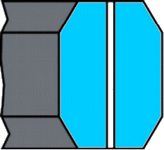
BX-type gaskets are only suitable for use with API type 6BX flanges and are designed to seal pressures up to 20000 psi. They are available with a pressure rating from 5000 psi to 20000 psi. The gasket differs from the R-type gasket in that it has a square cross-section with chamfered corners. These gaskets can only be used with API 6BX flanges and are not interchangeable with RX-type gaskets.
All BX gaskets have a pressure balance hole to ensure equalization of the pressure that can remain in the grooves. The pitch diameter of the ring joint is slightly larger than that of the flange groove. When the ring joint is installed, it remains pre-compressed by the outer diameter, creating a high seat pressure. When the BX gasket is correctly installed, it allows almost complete contact between the flange faces, which means that the gasket is completely locked in place on both the inner and outer diameters.
| NPS | type 6B | type 6B | type 6B | type 6BX | type 6BX | type 6BX | type 6BX | type 6BX | type 6BX |
| 2000 | 3000 | 5000 | 2000 | 3000 | 5000 | 10000 | 15000 | 20000 | |
| 1.13/16 | BX151 | BX151 | BX151 | ||||||
| 2.1/16 | R/RX23 | R/RX24 | R/RX24 | BX152 | BX152 | BX152 | |||
| 2.9/16 | R/RX26 | R/RX27 | R/RX27 | BX153 | BX153 | BX153 | |||
| 3.1/16 | BX154 | BX154 | BX154 | ||||||
| 3.1/8 | R/RX31 | R/RX31 | R/RX35 | ||||||
| 4.1/16 | R/RX37 | R/RX37 | R/RX39 | BX155 | BX155 | BX155 | |||
| 5.1/8 | R/RX41 | R/RX41 | R/RX44 | BX169 | BX169 | ||||
| 7.1/16 | R/RX45 | R/RX45 | R/RX46 | BX156 | BX156 | BX156 | |||
| 9 | R/RX49 | R/RX49 | R/RX50 | BX157 | BX157 | BX157 | |||
| 11 | R/RX53 | R/RX53 | R/RX54 | BX158 | BX158 | BX158 | |||
| 13.5/8 | R/RX57 | R/RX57 | BX160 | BX159 | BX159 | BX159 | |||
| 16.3/4 | R/RX65 | R/RX66 | BX162 | BX162 | |||||
| 18.3/4 | BX163 | BX164 | BX164 | ||||||
| 20.3/4 | R/RX74 | ||||||||
| 21.1/4 | R/RX73 | BX165 | BX166 | ||||||
| 26.3/4 | BX167 | BX168 | |||||||
| 30 | BX303 | BX303 |
In addition to the three standard types of ring joint gaskets mentioned in this article, special designs are also available or can be manufactured to your specifications.
Related Post(s)