
Transport and Storage of Crude Oil and Natural Gas
Before the refining process can take place, first the crude oil must be transported to a refinery. It is generally the case that all crude oils, natural gas, liquefied natural gas, liquefied petroleum gas (LPG) and petroleum products flow through pipelines at some time in their migration from the well to a refinery or gas plant, then to a terminal and eventually to the consumer.
Aboveground, underwater and underground pipelines, varying in size from several centimetres to a metre or more in diameter, move vast amounts of crude oil, natural gas, LHGs and liquid petroleum products. Pipelines run throughout the world, from the frozen tundra of Alaska and Siberia to the hot deserts of the Middle East, across rivers, lakes, seas, swamps and forests, over and through mountains and under cities and towns. Although the initial construction of pipelines is difficult and expensive, once they are built, properly maintained and operated, they provide one of the safest and most economical means of transporting these products.
The first successful crude-oil pipeline, a 5-cm-diameter wrought iron pipe 9 km long with a capacity of about 800 barrels a day, was opened in Pennsylvania (US) in 1865. Today, crude oil, compressed natural gas and liquid petroleum products are moved long distances through pipelines at speeds from 5.5 to 9 km per hour by large pumps or compressors located along the route of the pipeline at intervals ranging from 90 km to over 270 km. The distance between pumping or compressor stations is determined by the pump capacity, viscosity of the product, size of the pipeline and the type of terrain crossed. Regardless of these factors, pipeline pumping pressures and flow rates are controlled throughout the system to maintain a constant movement of product within the pipeline.
Marine Tankers and Barges
The majority of the world's crude oil is transported by tankers from producing areas such as the Middle
East and Africa to refineries in consumer areas such as Europe, Japan and the United States. Oil products
were originally transported in large barrels on cargo ships. The first tanker ship, which was built in
1886, carried about 2,300 SDWT (2,240 pounds per ton) of oil. Today's supertankers can be over 300 m
long and carry almost 200 times as much oil (see image below). Gathering and feeder pipelines often end
at marine terminals or offshore platform loading facilities, where the crude oil is loaded into tankers
or barges for transport to crude trunk pipelines or refineries. Petroleum products also are transported
from refineries to distribution terminals by tanker and barge. After delivering their cargoes, the vessels
return in ballast to loading facilities to repeat the sequence.
Oil tankers and barges are vessels designed with the engines and quarters at the rear of the vessel and the remainder of the vessel divided into special compartments (tanks) to carry crude oil and liquid petroleum products in bulk. Cargo pumps are located in pump rooms, and forced ventilation and inerting systems are provided to reduce the risk of fires and explosions in pump rooms and cargo compartments. Modern oil tankers and barges are built with double hulls and other protective and safety features required by the United States Oil Pollution Act of 1990 and the International Maritime Organization (IMO) tanker safety standards. Some new ship designs extend double hulls up the sides of the tankers to provide additional protection. Generally, large tankers carry crude oil and small tankers and barges carry petroleum products.
Supertankers
Ultra-large and very large crude carriers (ULCCs and VLCCs) are restricted by their size and draft to
specific routes of travel. ULCCs are vessels whose capacity is over 300,000 SDWTs, and VLCCs have capacities
ranging from 160,000 to 300,000 SDWTs. Most large crude carriers are not owned by oil companies, but
are chartered from transportation companies which specialize in operating these super-sized vessels.
Oil tankers
Oil tankers are smaller than VLCCs, and, in addition to ocean travel, they can navigate restricted passages
such as the Suez and Panama Canals, shallow coastal waters and estuaries. Large oil tankers, which range
from 25,000 to 160,000 SDWTs, usually carry crude oil or heavy residual products. Smaller oil tankers,
under 25,000 SDWT, usually carry gasoline, fuel oils and lubricants.
Barges
Barges operate mainly in coastal and inland waterways and rivers, alone or in groups of two or more,
and are either self-propelled or moved by tugboat. They may carry crude oil to refineries, but more often
are used as an inexpensive means of transporting petroleum products from refineries to distribution terminals.
Barges are also used to off-load cargo from tankers offshore whose draft or size does not allow them
to come to the dock.
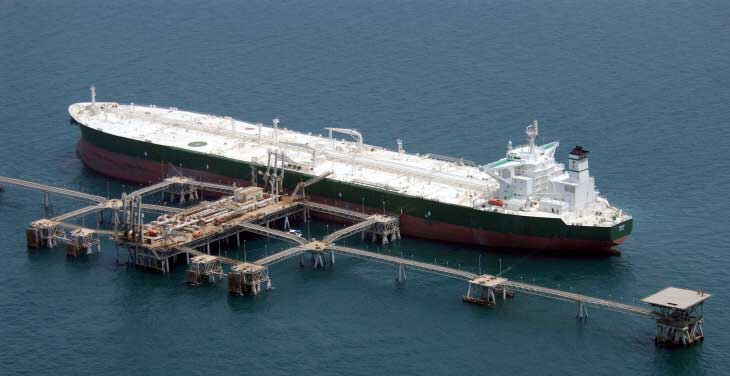
VSupertanker AbQaiq during loading
LNG and LPG marine vessels
Liquefied natural gas is shipped as a cryogenic gas in specialized marine vessels with heavily insulated
compartments or reservoirs (see image below). At the delivery port, the LNG is off-loaded to storage
facilities or regasification plants. Liquefied petroleum gas may be shipped both as a liquid in uninsulated
marine vessels and barges and as a cryogenic in insulated marine vessels. Additionally, LPG in containers
(bottled gas) may be shipped as cargo on marine vessels and barges.
The three types of marine vessels used for transport of LPG and LNG are..
- vessels with reservoirs pressurized up to 2 mPa (LPG only)
- vessels with heat-insulated reservoirs and a reduced pressure of 0.3 to 0.6 mPa (LPG only)
- cryogenic vessels with heat-insulated reservoirs pressurized close to atmospheric pressure (LPG and LNG)
Shipment of LHGs on marine vessels requires constant safety awareness. Transfer hoses must be suitable for the correct temperatures and pressures of the LHGs being handled. To prevent a flammable mixture of gas vapour and air, inert gas (nitrogen) blanketing is provided around reservoirs, and the area is continually monitored to detect leaks. Before loading, storage reservoirs should be inspected to ensure that they are free of contaminants. If reservoirs contain inert gas or air, they should be purged with LHG vapour prior to loading the LHG. Reservoirs should be constantly inspected to ensure integrity, and safety Valves should be installed to relieve the LHG vapour generated at maximum heat load. Marine vessels are provided with fire suppression systems and have comprehensive emergency response procedures in place.
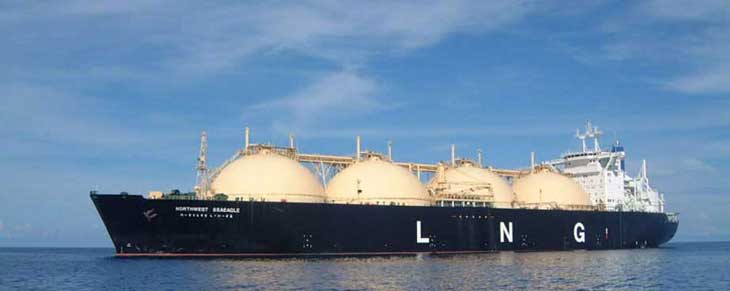
ss NORTHWEST SEAEAGLE - Liquid Natural Gas Carrier
Aboveground Tank Storage of Liquid Petroleum Products
Crude oil, gas, LNG and LPG, processing additives, chemicals and petroleum products are stored in aboveground and underground atmospheric (non-pressure) and pressure storage tanks. Storage tanks are located at the ends of feeder lines and gathering lines, along truck pipelines, at marine loading and unloading facilities and in refineries, terminals and bulk plants. This section covers aboveground atmospheric storage tanks in refinery, terminal and bulk plant tank farms. (Information concerning aboveground pressure tanks is covered below, and information concerning underground tanks and small aboveground tanks is in the article %quot;Motor vehicle fuelling and servicing operations".)
Terminals and bulk plants
Terminals are storage facilities which generally receive crude oil and petroleum products by trunk pipeline
or marine vessel. Terminals store and redistribute crude oil and petroleum products to refineries, other
terminals, bulk plants, service stations and consumers by pipelines, marine vessels, railroad tank cars
and tank trucks. Terminals may be owned and operated by oil companies, pipeline companies, independent
terminal operators, large industrial or commercial consumers or petroleum product distributors.
Bulk plants are usually smaller than terminals and typically receive petroleum products by rail tank car or tank truck, normally from terminals but occasionally direct from refineries. Bulk plants store and redistribute products to service stations and consumers by tank truck or tank wagon (small tank trucks of approximately 9,500 to 1,900 l capacity). Bulk plants may be operated by oil companies, distributors or independent owners.
Tank farms
Tank farms are groupings of storage tanks at producing fields, refineries, marine, pipeline and distribution
terminals and bulk plants which store crude oil and petroleum products. Within tank farms, individual
tanks or groups of two or more tanks are usually surrounded by enclosures called berms, dykes or fire
walls. These tank farm enclosures may vary in construction and height, from 45-cm earth berms around
piping and pumps inside dykes to concrete walls that are taller than the tanks they surround. Dykes may
be built of earth, clay or other materials; they are covered with gravel, limestone or sea shells to
control erosion; they vary in height and are wide enough for vehicles to drive along the top. The primary
functions of these enclosures are to contain, direct and divert rain water, physically separate tanks
to prevent the spread of fire in one area to another, and to contain a spill, release, leak or overflow
from a tank, pump or pipe within the area.
Dyke enclosures may be required by regulation or company policy to be sized and maintained to hold a specific amount of product. For example, a dyke enclosure may need to contain at least 110% of the capacity of the largest tank therein, allowing for the volume displaced by the other tanks and the amount of product remaining in the largest tank after hydrostatic equilibrium is reached. Dyke enclosures may also be required to be constructed with impervious clay or plastic liners to prevent spilled or released product from contaminating soil or groundwater.
Storage tanks
There are a number of different types of vertical and horizontal aboveground atmospheric and pressure
storage tanks in tank farms, which contain crude oil, petroleum feedstocks, intermediate stocks or finished
petroleum products. Their size, shape, design, configuration, and operation depend on the amount and
type of products stored and company or regulatory requirements. Aboveground vertical tanks may be provided
with double bottoms to prevent leakage onto the ground and cathodic protection to minimize corrosion.
Horizontal tanks may be constructed with double walls or placed in vaults to contain any leakage.
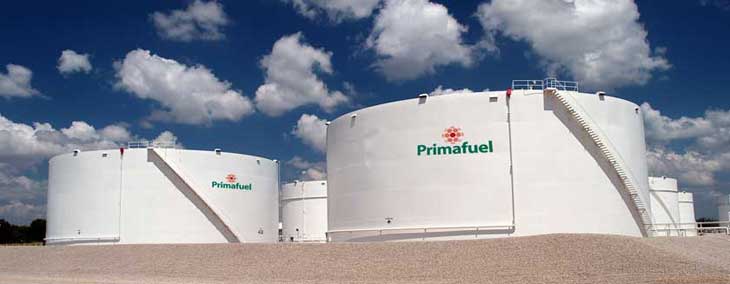
Primafuel, Tank Farm
Related Post(s)
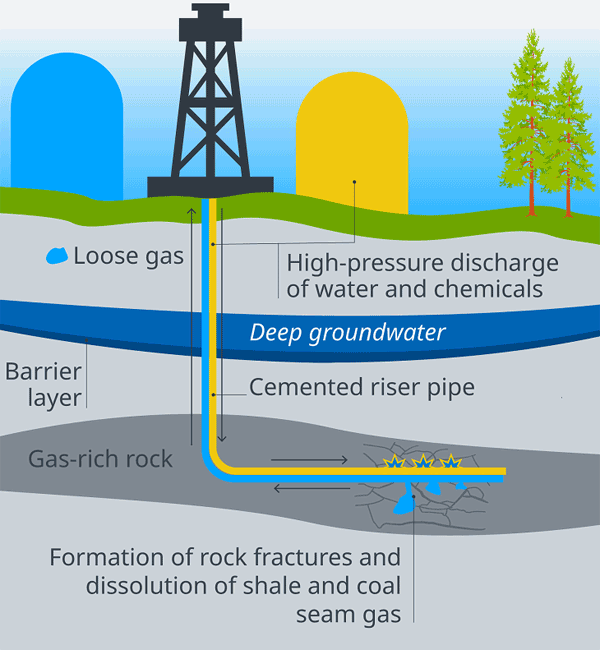
Fracking is a technique for increasing the permeability of rock so that oil, natural gas or geothermal energy can be extracted more easily...