
 |
MAG Welding (GMAW) |
MAG stands for “Metal Active Gas” welding and is an arc welding process in which a continuous metal wire is used as an electrode.
The electric arc melts both the wire and the base metal, while an active gas protects the molten pool from atmospheric contamination.
This active gas, often carbon dioxide (CO2) or a mixture with other gases, reacts chemically with the molten pool and thereby influences the properties of the weld.
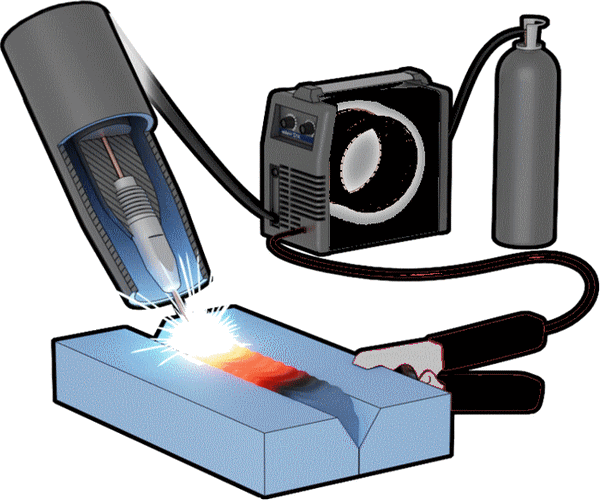 Image
source.. unknown
Image
source.. unknownApplications of MAG welding
MAG welding is widely used in the metalworking industry, particularly for welding ferrous metals such as carbon steel and low-alloy steel. The technique is especially popular in the following industries:
- Pipeline fabrication: When joining pipe sections for oil and gas pipelines.
- Construction: For composing steel beams and columns in buildings and bridges.
- Shipbuilding: In the construction of ship hulls and other maritime structures.
- Automotive industry: For welding body parts and chassis components.
- Agricultural Machinery: For the production of durable agricultural equipment.
Benefits of MAG welding
The popularity of MAG welding in these industries is due to various advantages, as the process offers a high melting rate, resulting in increased productivity.
The deep penetration of the welding process ensures strong, reliable welds. Moreover, the technique is relatively easy to automate, making it ideal for mass production.
MAG welding is cost-effective, particularly when using CO2 as a shielding gas.
What is the difference between MIG and MAG welding?
This is a frequently asked question, and although both techniques appear similar at first glance, but there are some crucial differences that affect their applicability.
MIG welding, which stands for “Metal Inert Gas” welding, uses inert gases such as argon or helium, and these gases do not chemically react with the molten pool.
MIG welding is often used for non-ferrous metals such as aluminum, stainless steel, and copper, and the process results in clean welds with minimal spatter.
MAG welding, on the other hand, uses active gases or gas mixtures, usually with a CO2 component. These gases react chemically with the molten pool, resulting in deeper penetration and a higher welding speed. MAG welding is particularly suitable for welding carbon steel and low-alloy steel.
The main difference lies in the gas used and the materials to which the techniques are best suited. In practice, the terms MIG and MAG are often used interchangeably, because modern welding equipment can perform both processes by switching gases.
Technique and parameters of MAG welding
For MAG welding, it is crucial to use the correct technique and parameters. One of the most important aspects is the proper setting of the welding machine. This includes selecting the correct amperage, voltage, and wire feed speed, depending on the material to be welded and the material thickness.
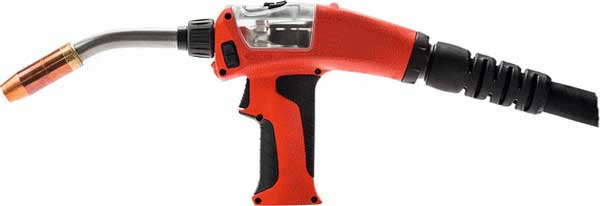 typical
MAG torch
typical
MAG torch(image courtesy of Fronius International)
The angle of the welding torch plays an important role, and for most applications, a forward angle of approximately 10–15 degrees is recommended. This angle ensures good visibility of the welder over the weld pool and contributes to effective gas shielding.
The speed at which the welder moves the welding torch (welding speed) affects the penetration depth and the width of the weld bead.
A speed that is too high can lead to insufficient penetration, while a speed that is too low can cause excessive heat input and distortion.
is also important to maintain the correct wire stick-out length – the length of the wire that protrudes from the contact tip. A stick-out length that is too long can lead to arc instability and insufficient gas shielding, while a stick-out length that is too short can cause overheating of the contact tip.
In conclusion.. Professional welders possess the knowledge and experience to consistently produce high-quality welds, regardless of project complexity. They are familiar with various materials and welding positions and can quickly identify and resolve problems. Furthermore, professional welding companies have advanced equipment and can often offer a wider range of services, such as weld design and quality control.
References..
hyeswelder.com
heijnenservices.nl
Related Post(s)
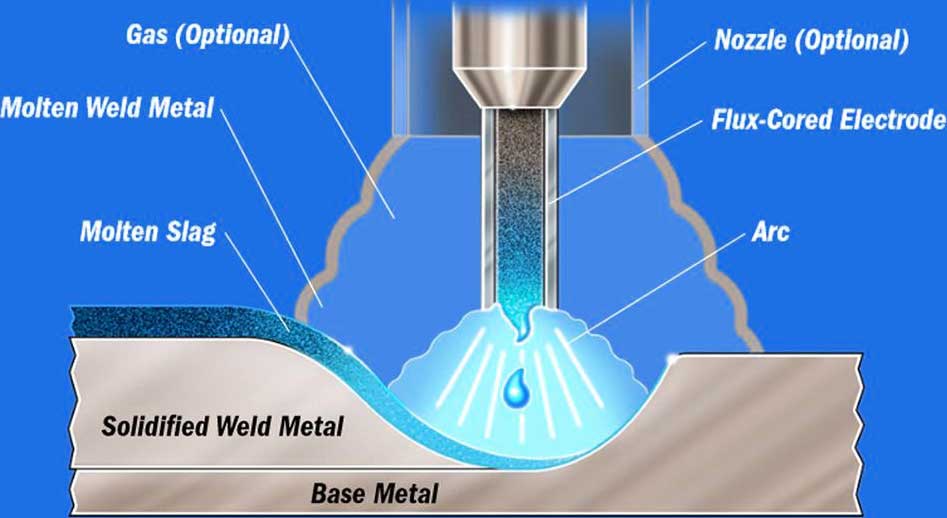
Flux-Cored Arc Welding is a welding method that is somewhat unique compared to Metal Inert Gas welding (MIG)...